- Home
- >
- Victorian Budget
- >
A deep dive on the 2026 Victorian Budget
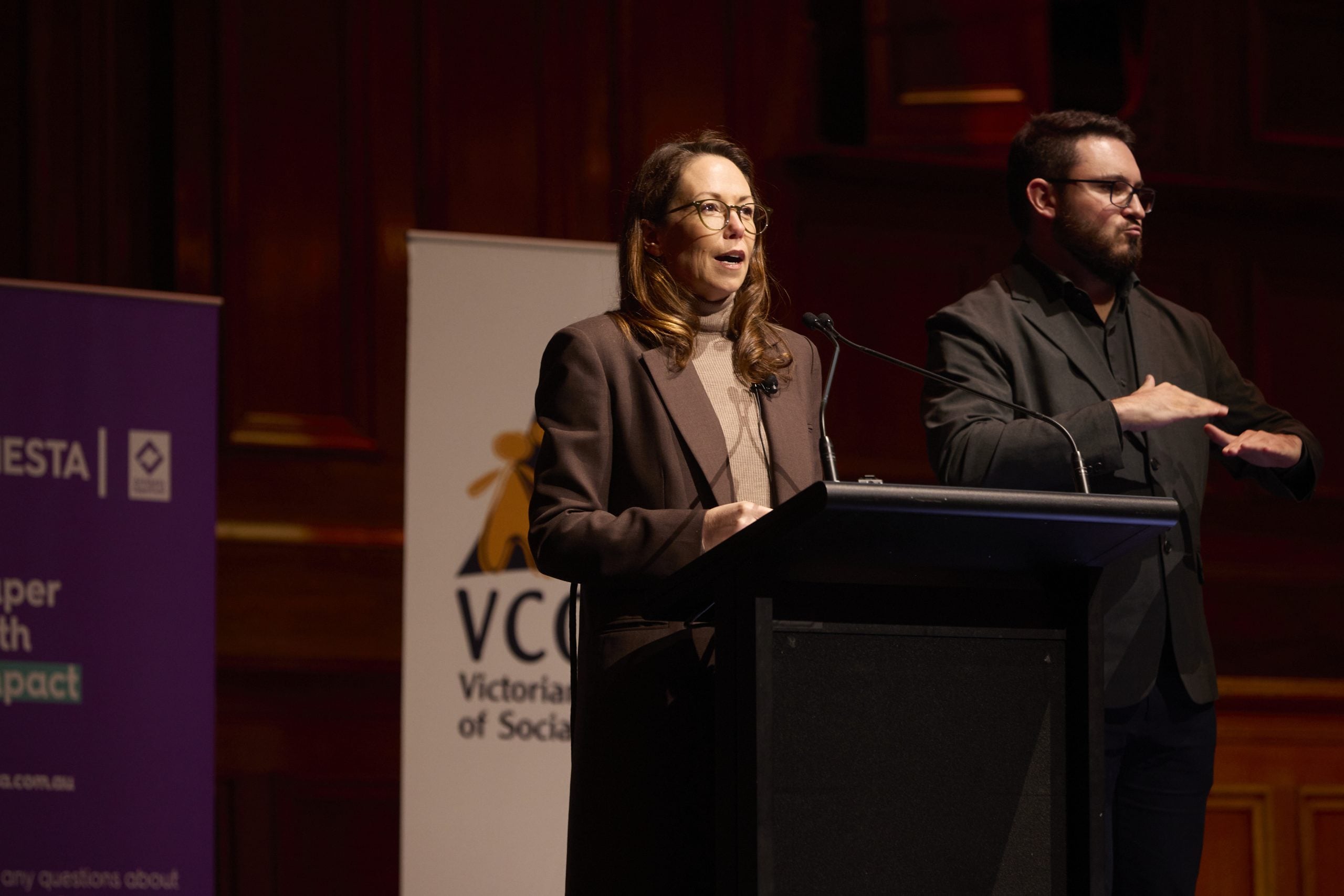
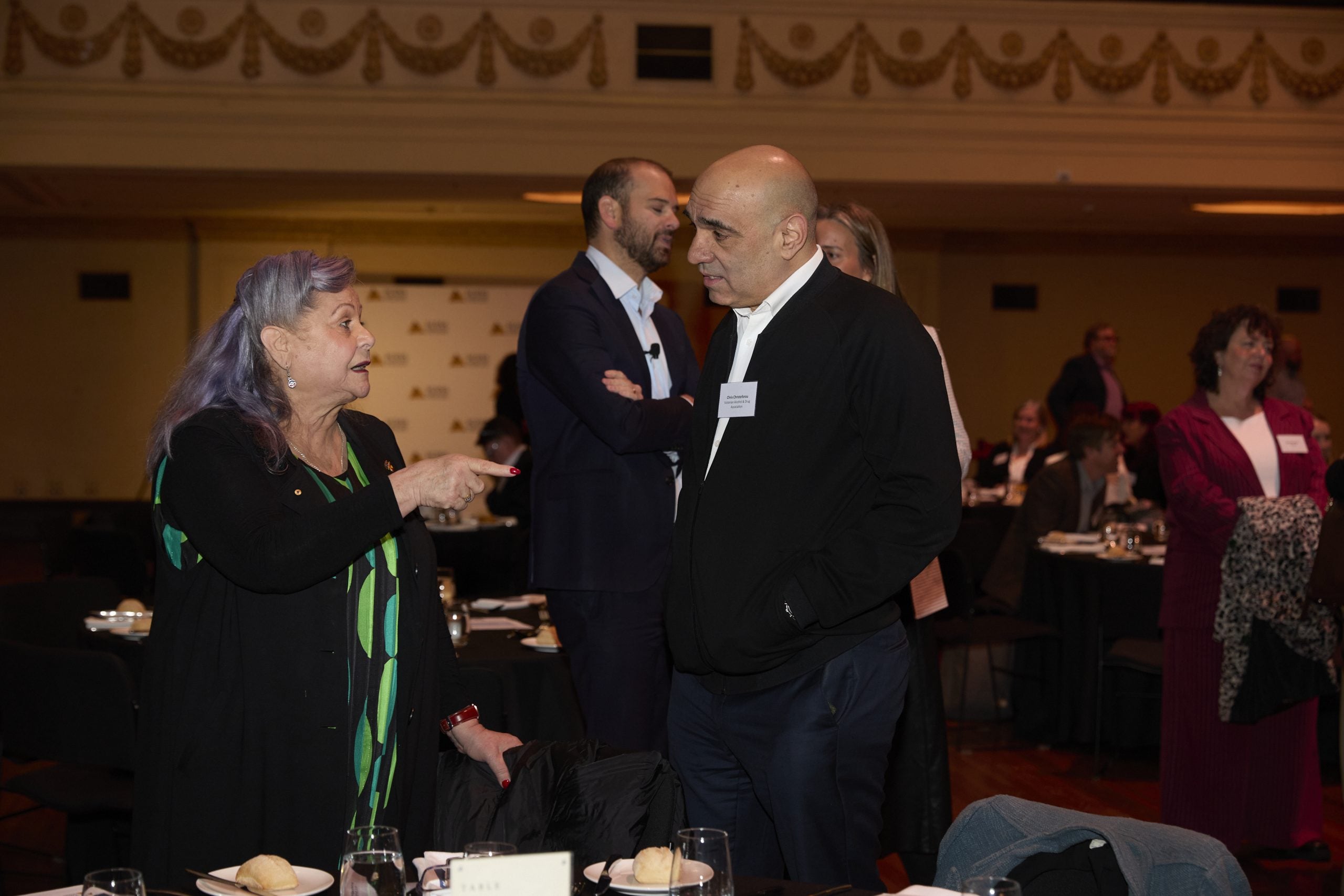
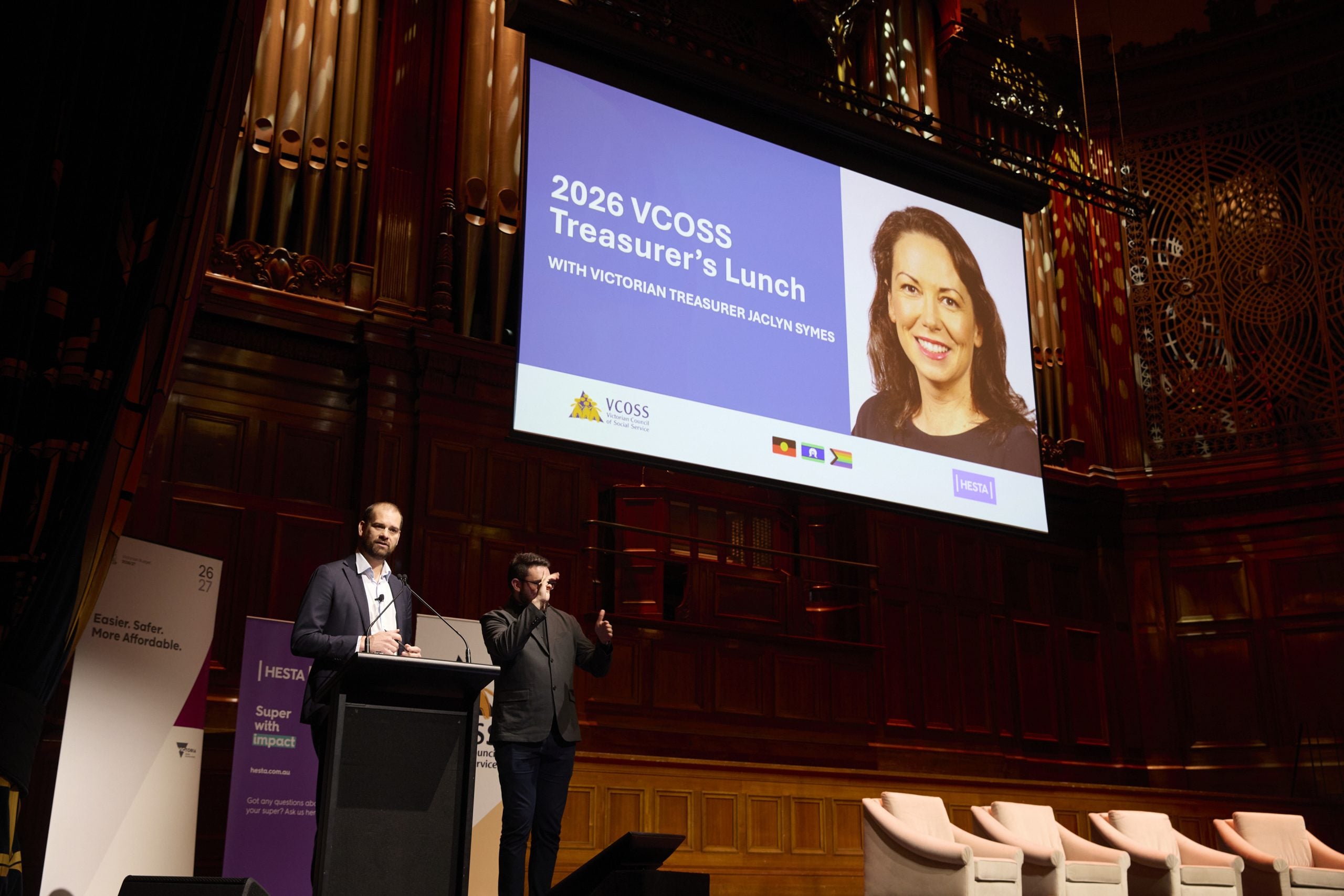
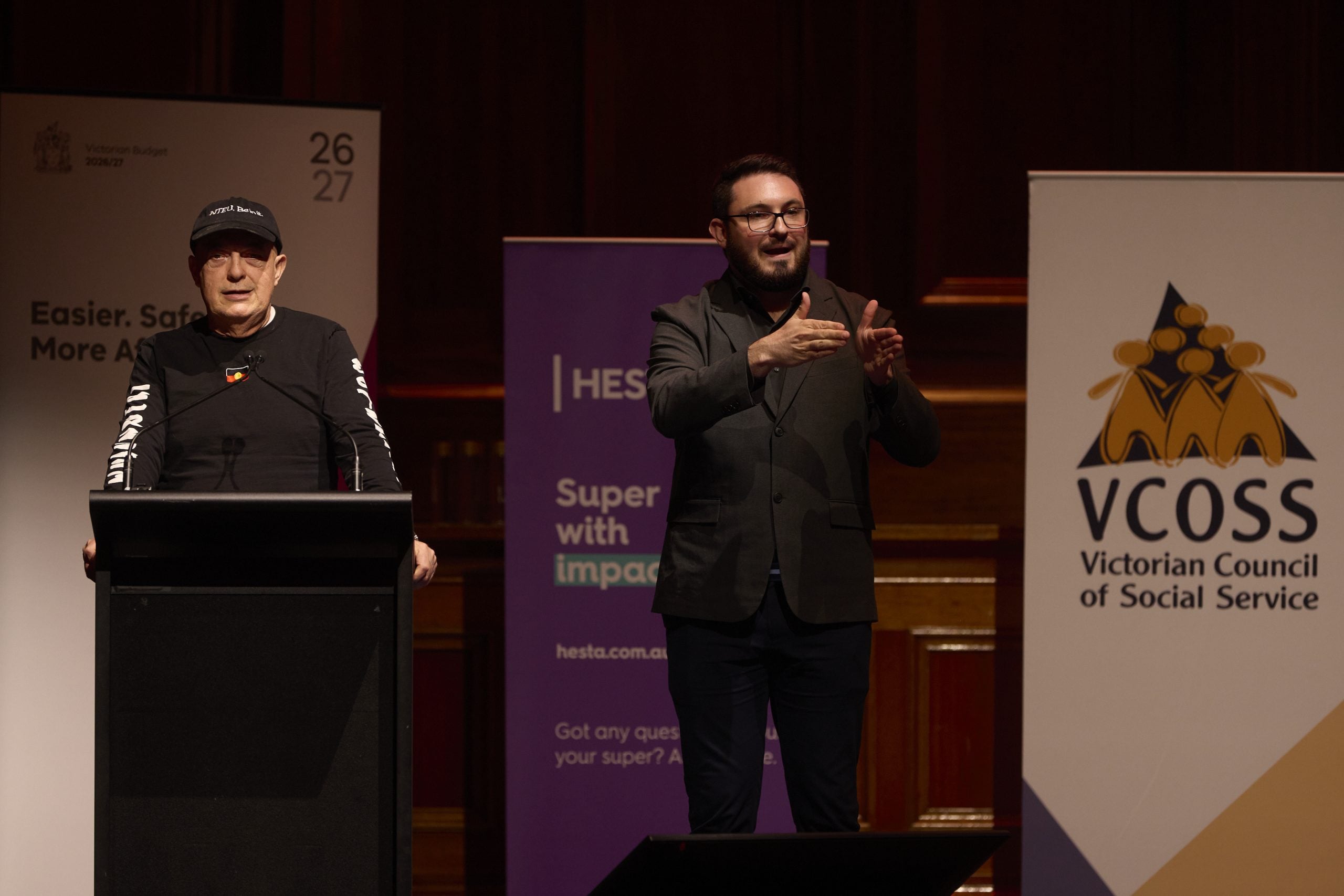
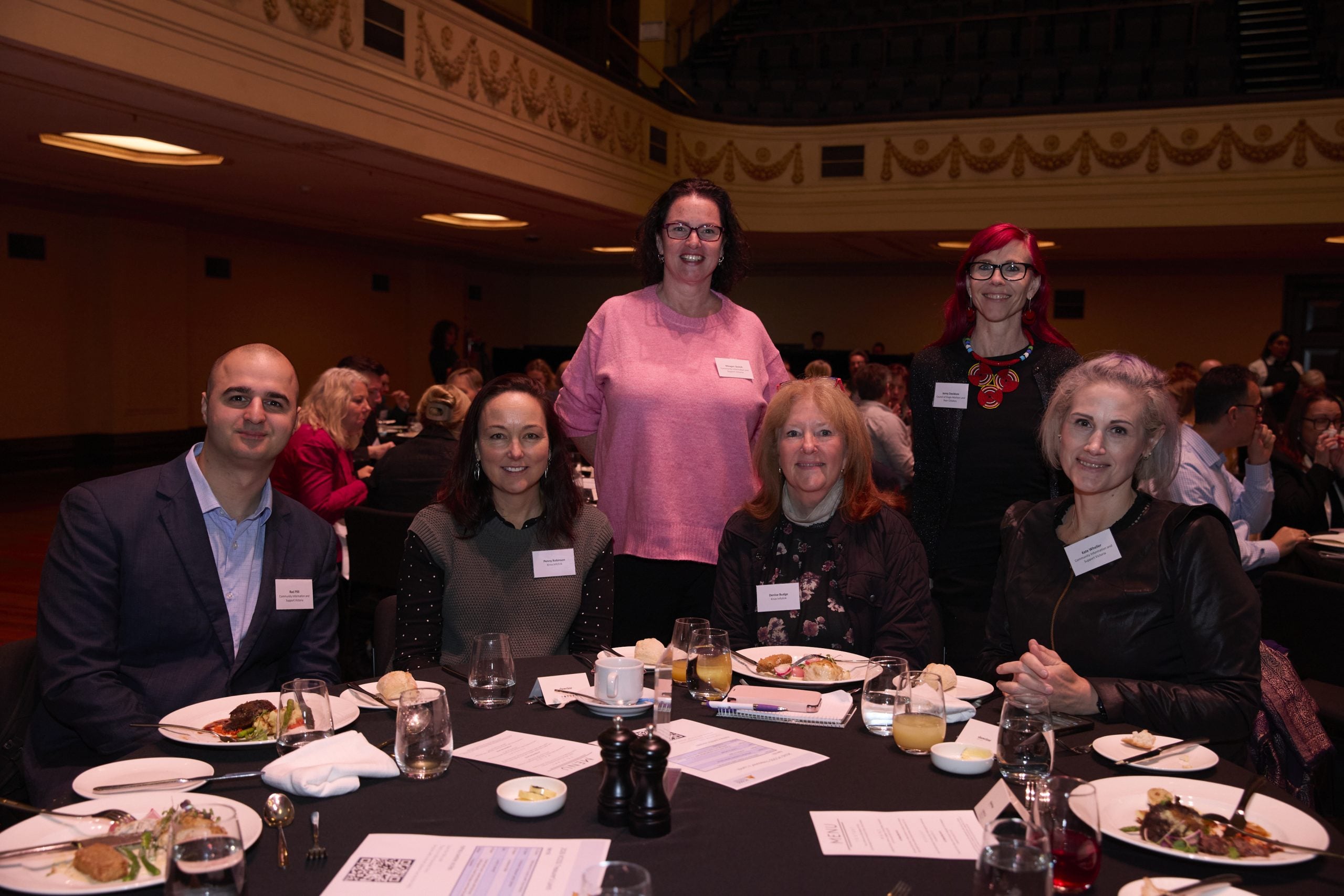
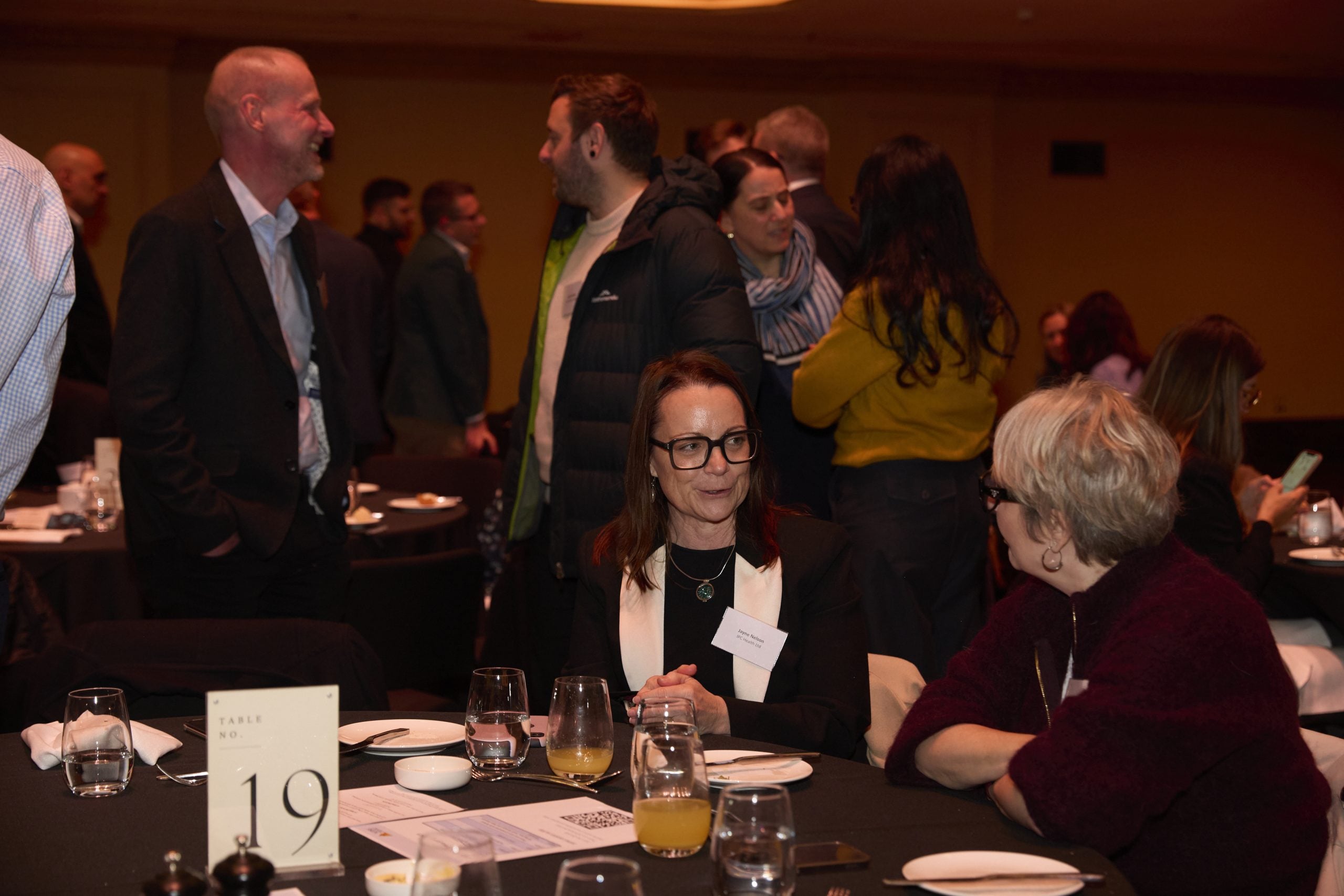
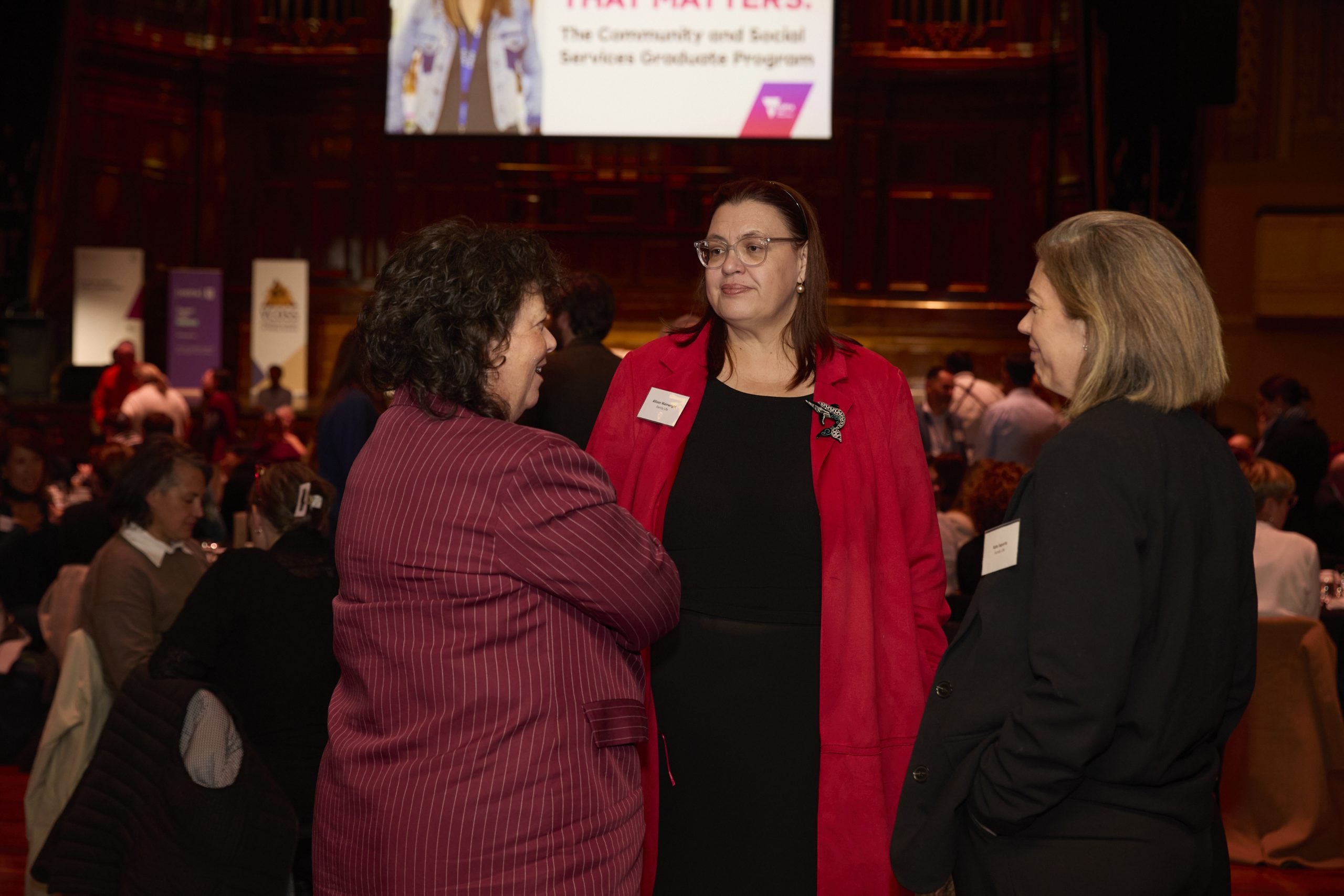
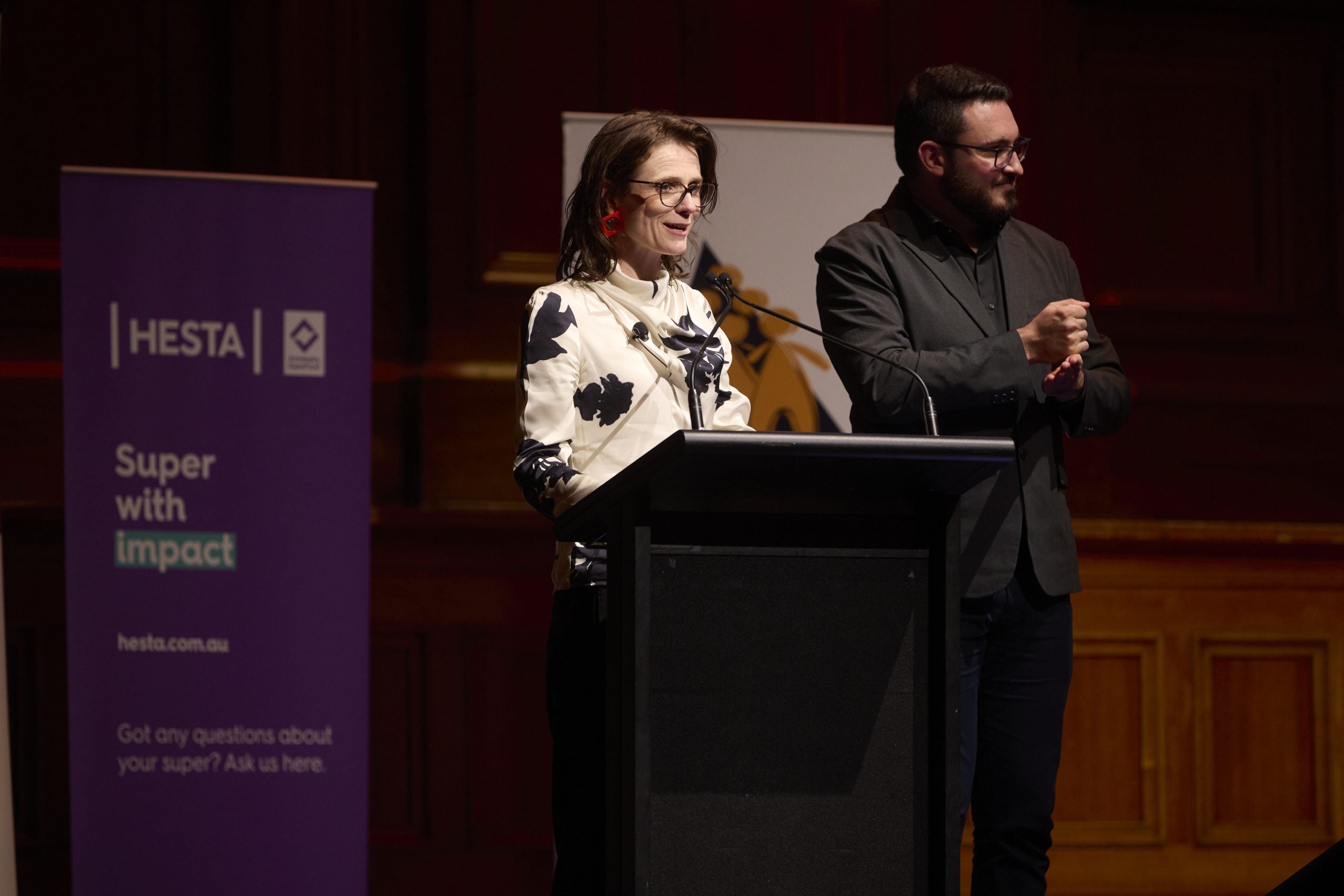
Images from the 2026 VCOSS Treasurer’s Lunch
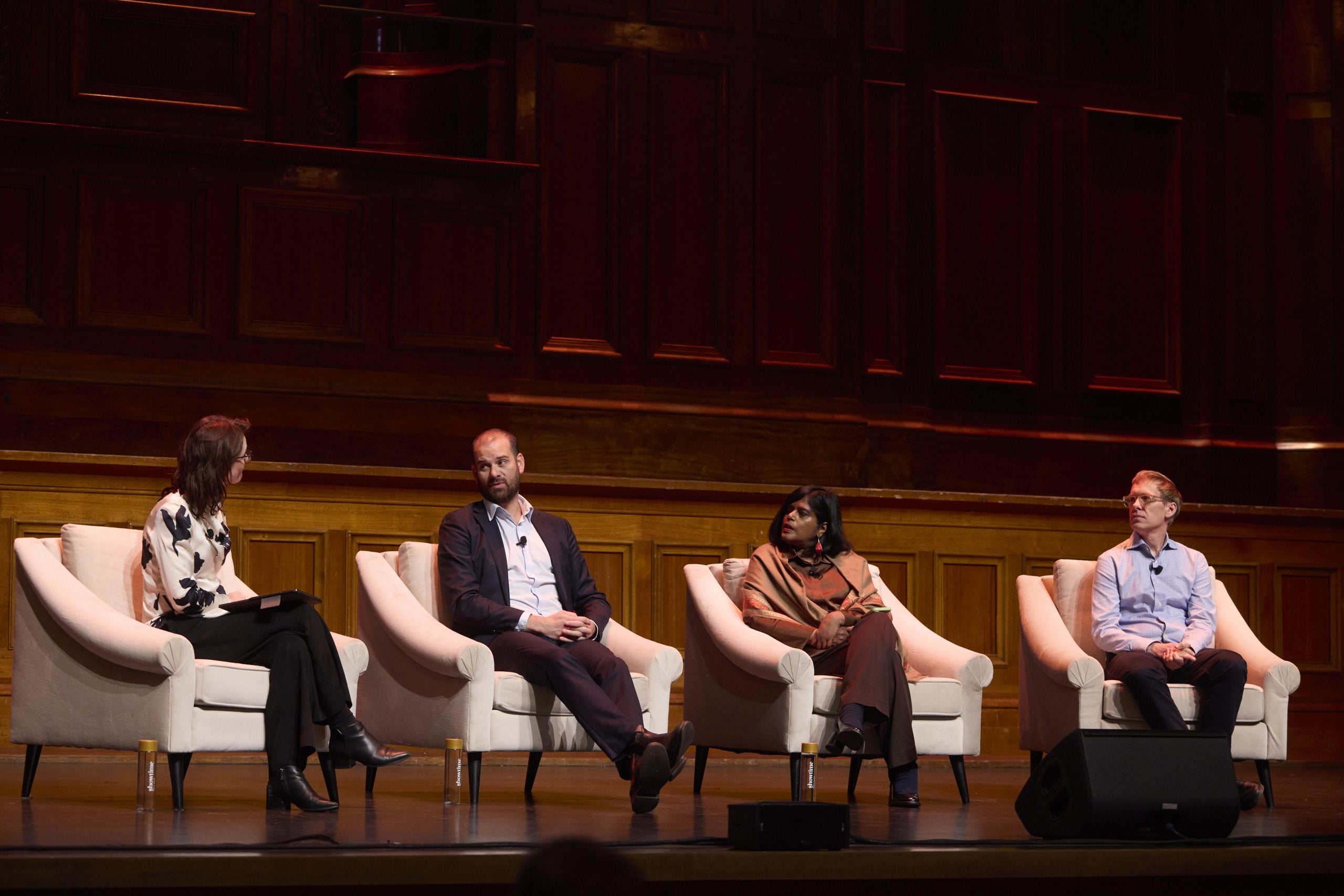
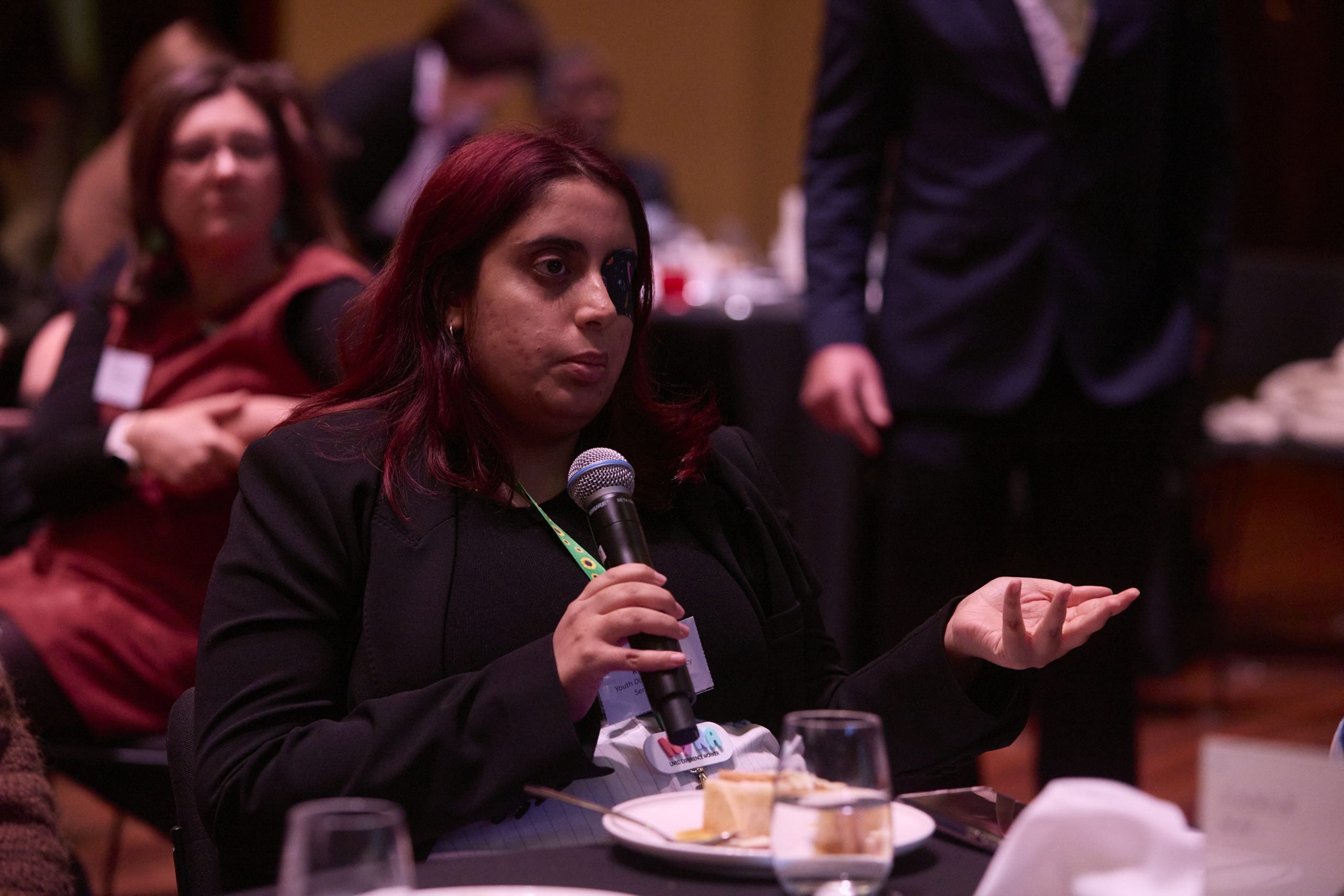
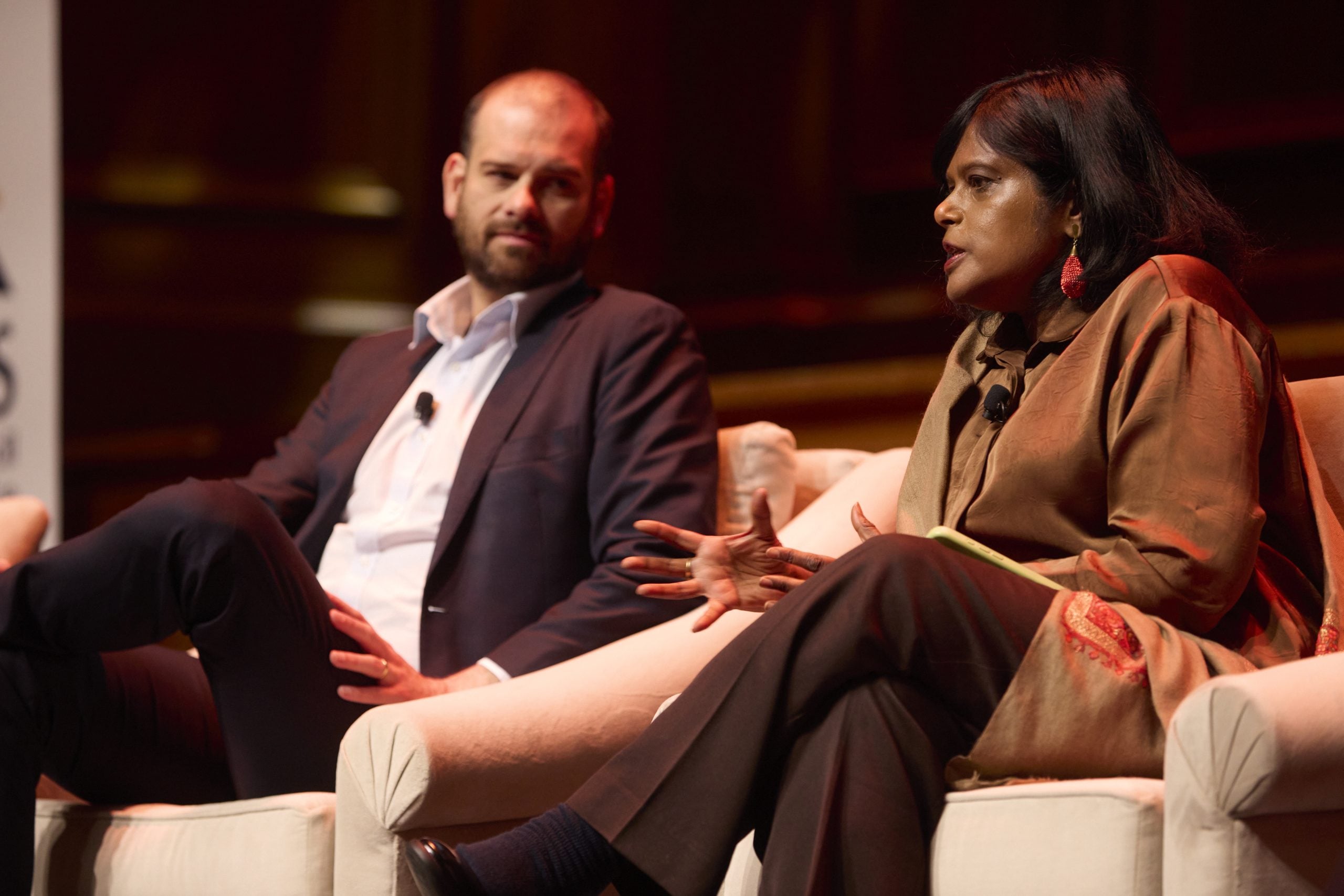
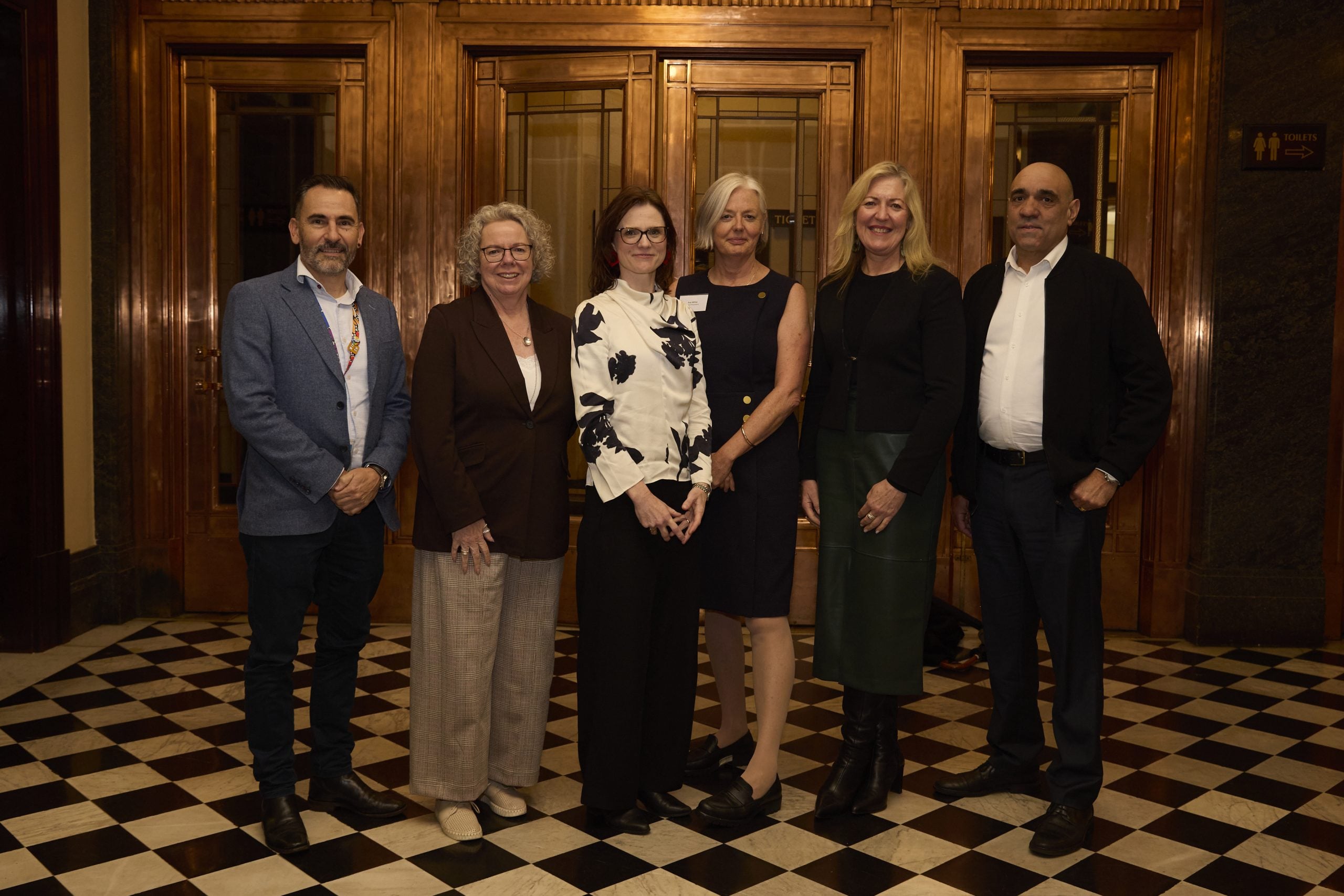
Options:
Jump to detailed budget analysis.
Read the VCOSS budget media release.
Watch this space for Treasurer’s Lunch videos.


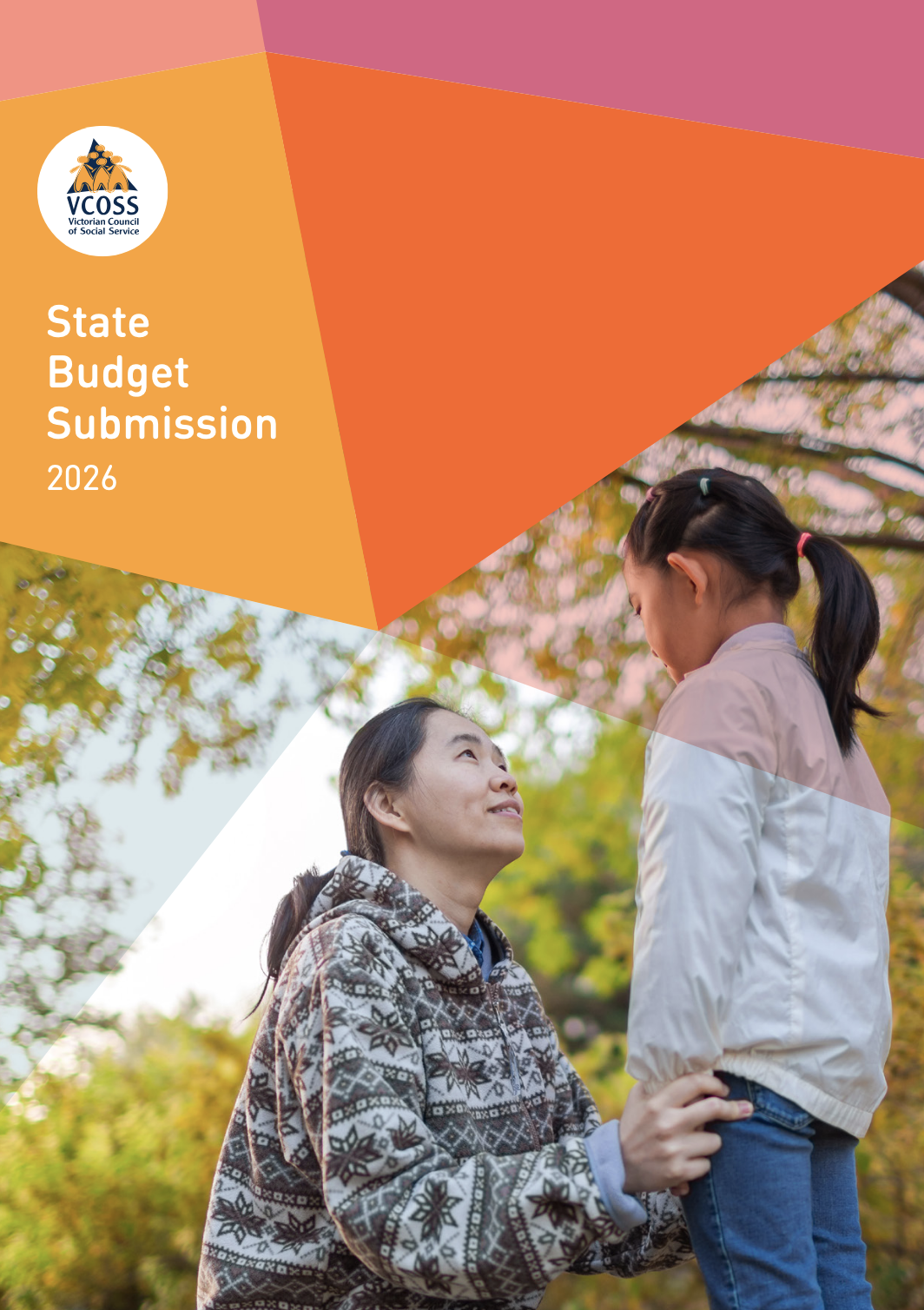
VCOSS CEO Juanita Pope addressing members after the release of the 2026 Victorian Budget. Read our budget day media release here.
Fixing our housing system
Significant initiatives
- Social Housing Growth Fund and Affordable Housing Investment Partnerships expansion
$193m in 2026-27 ($859.7/5yrs) expands investment in the Social Housing Growth Fund to deliver more than 7,000 new social housing homes by the community housing sector over the next 10 years. - Rent-to-buy for First Peoples
$14.5m in 2026-27 ($16m/4yrs) to deliver a Rent-to-Buy pilot for First Peoples to support increased home ownership. - Continuing supportive housing for rough sleepers using a Housing First model
$6.1m in 2026-27 (15.1/2 yrs) to continue critical service delivery operations at five supportive housing sites across Victoria. - Making homelessness rare and non-recurring
$6.2m in 2026-27 ($25.8/4yrs) for critical homelessness services to tackle rough sleeping and help people escape the cycle of homelessness. - Support for renters to maintain tenancies
$3.0m in 2026-27 ($6.1/2yrs) to expand the Tenancy Plus program, which provides support for social housing renters who are at risk of losing their homes and becoming homeless. Funding will also support First Peoples social housing tenants.
What’s good
- The Government has committed to build 7,000 new community housing properties through the ‘Social Housing Growth Fund and Affordable Housing Investment Partnerships expansion’, with 10% allocated to better housing supply and services for First Peoples. While this is a critical baseline, decades of under-investment in social housing has left Victoria with the lowest proportion of social housing nationally, and average wait times exceed 18 months. The Victorian Housing Peaks Alliance’s ‘Growing Social Housing’ report paints a stark picture of unmet demand. VCOSS continues to call for a ten‑year target of at least 7,990 new social housing homes per year, supported by sustained public investment and inclusionary zoning.
- This Budget allocates $16m to deliver a Rent-To-Buy pilot for First Peoples. A key aim for Mana-na worn-tyeen maar-takoort is for Aboriginal home ownership levels to match those of other Victorians – the establishment of this scheme is a positive step in unlocking these opportunities. However, current funding will only provide 30 newly constructed affordable rental dwellings, which is significantly lower than what is needed to meet demand. We note that this is not a new investment.
- This Budget makes some critical investments in the specialist homelessness sector, including continued funding to maintain delivery operations at five supportive housing sites. These sites provide wrap-around supports to enable people to exit homelessness. VCOSS also welcomed the funding injection through the Budget measure ‘Making homelessness rare and non-recurring’. We understand this funding will expand assertive outreach services which seek out, engage, and support people experiencing homelessness who are not currently engaging with services[1], ass well as funding to provide additional emergency accommodation to people experiencing homelessness.
- Tenancy advocacy is critical for protecting renters’ rights, preventing homelessness, and addressing power imbalances. VCOSS is pleased to see this Budget builds on recent investments which doubled funding for private renter support and provides a 30% increase in funding for Tenancy Plus – a critical program which supports social housing residents to maintain their tenancies.
[1] CHP’s newly released report identified that Victoria needs to expand its assertive outreach workforce to at least 177 workers across the state. This funding is an important step towards meeting this need. Council to Homeless Persons 2026, ‘Too Short a Lifeline – Mapping Assertive Outreach report’, Too Short a Lifeline – Mapping Assertive Outreach report – Council to Homeless Persons website.
What’s missing
- While the $860m committed to social housing is welcomed, VCOSS notes this funding is being transferred into the Social Housing Growth Fund – which enables the building of community housing dwellings. VCOSS calls on the Victorian Government to set a bold social housing target that commits to the expansion of both public and community housing stock. According to Productivity Commission 2026 data[1], Victoria has delivered just 36 new public housing dwellings since 2016.
- Aboriginal Community Controlled Organisations are for calling for an Aboriginal Homelessness Target and an Aboriginal Social Housing Growth Policy. These two measures are central to the full implementation of Mana-na worn-tyeen maar-takoort. We also note this Budget did not allocate a funding uplift to the Aboriginal Private Rental Assistance Program or the Private Rental Assistance Program.
- Access to long-term and safe housing is vital to ensure young people have the opportunities to flourish in life. This Budget falls short in providing young people the required investment to address youth homelessness. VCOSS continues our long-standing call for a co-designed Victorian Youth Homelessness Strategy which would guide whole-of-government policy-making, improve service system coordination and drive investment to end youth homelessness. A key priority would be to deliver 500 supported housing places for young people experiencing homelessness and mental ill health, as committed to as part of the Royal Commission into Mental Health.
- Implementation of the Social Housing Regulation Review is a priority for VCOSS members and the people they support. The independent Panel’s Social Housing Regulation Review Final Report and the Government’s formal response were both published in December 2024 and provide a robust roadmap for social housing regulatory reform. VCOSS is disappointed to see this Budget does not deliver the necessary funding to action the report’s recommendations, including the development of a single advocacy body for social housing tenants.
[1] Productivity Commission 2026, ‘Report on Government Services 2026’, https://www.pc.gov.au/ongoing/report-on-government-services/housing-homelessness/housing.
What have VCOSS members had to say?
- “Budget delivers welcome new money, but homelessness crisis still needs more.” Council to Homeless Persons
Providing cost-of-living relief for those who need it most
Significant initiatives
This section provides analysis of the spending committed towards reducing transport and food costs, creating energy affordability, and supports for people experiencing financial hardship. Acknowledging that housing, healthcare, and education make up large parts of the cost of living, please see those sections for further analysis.
Food costs
- Strengthening food security across Victoria
$8.5m in 2026-27 ($11.2m/2 yrs) increasing support for the Community Food Security program, Foodbank Victoria and regional foodshares to support local food relief initiatives. Funding is also provided to meet food security system and infrastructure gaps to improve access to food relief across the state.
Services that help Victorians who are experiencing financial hardship
- Expanding place-based legal, financial and personal advice services for vulnerable Victorians
$600k in 2026-27 ($2.4m/2 yrs) for the geographical expansion of place-based community information and support services to support Victorians experiencing personal and financial hardship. - Expansion of financial counselling services
$2.7m in 2026-27 for additional front-line financial counsellors to address geographical expansion of service delivery in line with population growth
What’s good
- VCOSS welcomes the announcement of free public transport until the end of May, and half price public transport for the rest of 2026. This initiative will reduce demand for fuel at a time of global energy crisis and reduces a key cost of living pressure for many Victorians. Reducing the price of public transport also facilitates better mobility, improved social connection and inclusion, and reduced emissions.
- Funding for more train and bus services is also a crucial piece of the puzzle for expanding access to public transport, and VCOSS is particularly pleased to see funding for more bus and train services in outer-urban, rural and regional areas. See the climate section for further commentary on additional bus services.
- This budget delivers much needed resourcing to upgrade tram stops and phase out old high-floor trams. Disability advocates have been calling for full accessibility on Melbourne trams for decades. However, a lot of work remains to be done to ensure the tram network is fully accessible in line with the Government’s legal obligations under the Australian Disability Standards for Accessible Public Transport 2002.
- VCOSS was pleased to see a renewal in funding for the Energy Assistance Program, which provides advocacy services on behalf of energy consumers experiencing hardship. However, we strongly recommend that services like this, which have become a crucial part of the energy landscape in Victoria, are provided certainty and stability with longer-term funding, rather than single-year continuations.
- The extension of Solar Homes hot water rebates for one year is welcome. These rebates reduce the cost of upgrading appliances from fossil gas burning units to efficient electric alternatives. This reduces emissions and lowers running costs. However, VCOSS would like to see the program refunded long-term, rather than year on year, and additional grants and rebates provided to those on the lowest incomes to make up the remaining gap in affordability for upfront costs.
- The budget also included welcome funding for the training of tradespeople in the work needed to electrify homes and improve energy efficiency, see the climate section for details on these spending lines.
- Increased support for food relief is welcome, particularly given pressures on Victorian household budgets due to the fuel crisis. Community and volunteer organisations are managing increasing levels of demand for food relief, and many report out of pocket expenses related to food provision, including storage and staff costs. The grants provided as part of the Community Food Security Program will help to offset some of these costs in 2026-27.
- VCOSS acknowledges the continued support for regional foodshares. These six community-owned hubs across Victoria rescue, source and supply food to local organisations, schools and families experiencing food insecurity. In 2024-25 they provided food for over 6 million meals, as well as strengthening food literacy skills and social capital via volunteering and community engagement opportunities.
- The budget also included investment in the electrification of our food supply chains, which has the potential to increase resilience and reduce emissions. See the climate section for further commentary.
What’s missing
- While a discount on vehicle registration will be welcome cost of living relief for many Victorians, the cost to the State is very high at nearly $760 million. VCOSS believes the money could have been better spent on targeted measures that tackle the structural drivers of poverty and disadvantage. For example, the Victorian Government could have increased its spend on social housing, provided more public transport services in regional areas, or significantly boosted funding for community sector services. Any one of these options, and many more, would improve the wellbeing of Victorians experiencing hardship in more significant ways and over a longer term than a one-off cost reduction on registration.
- In VCOSS’ pre-budget submission, we called for the Victorian Government to fund the Essential Services Commission to develop a Rent Increase Fairness Formula, that can be legislated to deliver more certainty and fairness for renters, rental providers and property managers in the private market. See the Housing section for further commentary on housing costs.
- The Victorian Government and Essential Services Commission have made strong moves to tackle energy costs, including significant investment in the transition to renewables and new consumer protections to ensure consumers are more likely to get better prices. But VCOSS is keen to see further investment tackling the structural drivers of high energy costs and energy hardship. In our pre-Budget submission, some of the recommendations we highlighted were to:
- Introduce an affordable social tariff for essential energy for those who cannot afford ongoing costs in the market.
- Increase the Utility Relief Grant to $1,000 to reflect current rates of energy debt.
- Scale innovative place-based models (for example, ‘Bring Your Bills’ days) that have demonstrated success in identifying people in hidden energy hardship and connecting them to support.
- Continue to invest in ambitious regulatory reform of the energy market by moving towards banning disconnections, reducing barriers to accessing cheaper plans, reforming embedded networks, and improving retailer hardship support.
- Utilise the State Electricity Commission as a public and affordable energy retailer and continue to direct the SEC to be an impact investor in the renewable transition, especially in community-led place-based initiatives in rural and regional areas.
- While investment in food relief is welcome, the Budget does not address the structural drivers of food insecurity. In our pre-Budget submission, VCOSS called on the Government to fund recommendations of the Victorian Parliamentary Inquiry into Food Security. Initial investments should include:
- The development of a Victorian Food Security Strategy to address the drivers of food security and drive long-term investment in building a resilient, sustainable food system (Recommendation 15).
- A comprehensive audit of food relief services to identify service gaps. This data would be used to build and maintain a real-time Food Relief Services Map for providers and the public, enabling better coordination across the system (Recommendation 20).
- A change to the funding model for the food relief sector – moving from short-term grants to recurrent funding (Recommendation 21).
- It is terrific to see financial counselling acknowledged as a crucial response to higher cost of living, and accordingly, funded for additional places to account for population growth. However, the uplift falls well short of what the sector is calling for, and only provides for a single year, making expansion difficult. Financial Counselling Victoria’s pre-budget submission makes the case for a quadrupling of funding over 10 years to meet the increasingly complex and diverse needs of the Victorian community. We note that the full Government response to the Consumer Affairs Victoria Review of the financial counselling program is still pending, and further announcements may be made.
What have VCOSS members had to say?
- “It was particularly pleasing to see that financial counselling featured prominently” Financial Counselling Victoria
Keeping All Victorians Healthy
Significant initiatives
First Nations Health
- Wathaurong Dreaming Project
$12.7 million in 2026-27 ($26.4 million/2 years) to redevelop Wathaurong Aboriginal Co-operative’s premises in North Geelong, delivering a fit-for-purpose, culturally safe space designed to provide comprehensive and integrated health and wellbeing services to the local Aboriginal and Torres Strait Islander community.
Community Health
- Community-based chronic disease program
$4.3 million in 2026-27 ($21.2 million over 4 years)to deliver additional hours of care for more than 4,500 people living with a chronic disease through registered community health services. - Home and Community Care Program for Younger People
Supports for people with disability outside of the NDIS $22.5 million in 2026-27 to maintain delivery of the Home and Community Care Program for Younger People
Mental Health
- Expanding Thomas Embling Hospital
$9.6 million in 2026-27 ($125.1 million/ 4 years) for 40 new forensic mental health beds. - Supporting groups disproportionately impacted by suicide
$5.4 million in 2026-27 ($6.5 million/2 years) to continue the LGBTQIA+ aftercare program delivered by Mind Australia; the Standby Support After Suicide postvention program; and clinical uplift support for the Hospital Outreach Post-suicidal Engagement (HOPE) program. Funding also continues Aboriginal and Torres Strait Islander suicide prevention led by the Balit Durn Durn Centre and the Aboriginal Medico-Legal Support Officer position at the Victorian Institute of Forensic Medicine. - Mental Health and Wellbeing Hubs
$4.9 million in 2026-27 to continue the community-based Mental Health and Wellbeing Hubs network, which provides accessible mental health and wellbeing support to Victorians across the state.
Alcohol and Other Drugs
- Victoria Pill Testing
$5.4 million in 2026-27 ($9.6 million/2yrs) to establish Victoria’s first fixed-site drug checking service in Melbourne’s CBD alongside a mobile drug checking service, enabling people who use drugs to make safer, more informed decisions and avoid accidental overdose. These services remove stigma from what is fundamentally a health issue and reflects an evidence-based approach to harm reduction. - Public Intoxication Services
$28.5 million in 2026-27 ($52.3 million over 2 years)to continue a health led response to the decriminalisation of public intoxication and deliver improved outcomes to vulnerable communities. This includes the continuation of general outreach and sobering service response in Metro Melbourne. As well as specific First nations-led outreach, monitoring and evaluation and places of safety to support a health-led response to public intoxication, and a self-determined pharmacotherapy model.
Women’s Health
- Preventative health support for Victorian women
$9.8 million in 2026-27 ($10.4m/2years) for preventative health support for Victorian women, including peer-led sexual health services for sex workers and support for 12 women’s health organisations across Victoria.
What’s good
- The Community-Based Chronic Disease Program will support more than 4,500 Victorians living with chronic illness to better manage their health and get care closer to home, without the need to go to hospital. This type of investment in community-based care will help clients navigate the health system, improve their health literacy and engagement, and connect them with services and programs to manage their condition in the community. The four-year investment provides certainty for both community health providers and the people they serve.
- The Wathaurong Dreaming Project is a welcome investment in Aboriginal Community Controlled Organisations (ACCOs) health infrastructure. Fit-for-purpose facilities are foundational to ACCOs being able to deliver the comprehensive, integrated and culturally safe care that Aboriginal and Torres Strait Islander communities need and have a right to expect. While we support this investment VCOSS and VACCHO note that significant need for infrastructure persists across the state. VACCHO and Infrastructure Victoria identified that $150 million is required to meet the immediate health and wellbeing infrastructure needs of Victorian ACCOs, with a further $30 million per year needed for urgent maintenance[1].
- Additional investment in forensic mental health through the Thomas Embling Hospital to provide secure, specialised therapeutic treatment for patients with severe mental illness in the criminal justice system. These new beds will free up prison bed capacity and support appropriate care outside of a custodial setting. Funding for expansion reflects an important recognition that people with severe mental illness in the criminal justice system deserve therapeutic treatment, not simply incarceration.
- Continued funding of $22.5 million for the Home and Community Care Program will enable independent living in the home and community for people with disability outside the NDIS. Funding is also provided to assess people with disability seeking to have allied health supports included within their NDIS plans. VCOSS notes that the funding is a one-year allocation only. Thousands of Victorians with disability rely on this program to live independently, but short‑term funding drives instability across the workforce and services to plan ahead, weakening the support that enables independent living.
[1] Infrastructure Victoria and Victorian Aboriginal Community Controlled Health Organisation (VACCHO), Investing in Aboriginal health and wellbeing infrastructure: securing safe and sustainable Community-controlled care, April 15, 2025, https://www.infrastructurevictoria.com.au/resources/investing-in-aboriginal-health-infrastructure
What’s missing
- Community health services are the backbone of primary and preventative care for low‑income and vulnerable Victorians, delivering integrated, low‑barrier services that reduce illness and ease pressure on hospitals. Demand has continued to grow while core funding has not meaningfully increased. The Budget provided no core funding uplift for community health services, despite rising demand and complexity. VCOSS proposed a $100 million investment over four years; without additional funding, services will need to meet growing need within existing resources, limiting access for higher‑need communities and increasing pressure on the acute system over time.
- Equally absent is any commitment to the Community Health Infrastructure Fund. VCOSS called for a $200 million capital fund to address the chronic underinvestment in community health buildings and equipment. Many community health centres operate in facilities that are decades old and are simply not fit for the integrated, multi-disciplinary service models that communities need. Without fit-for-purpose infrastructure, the sector cannot deliver the scope and quality of care required.
- This Budget again failed to fund critical First Nations health priorities, including the two Aboriginal Health and Wellbeing Centres recommended by the Royal Commission into the Victorian Mental Health System. For the second consecutive year, this disregards the Royal Commission’s call for Aboriginal‑led healing infrastructure to strengthen Aboriginal social and emotional wellbeing and the priorities of the Aboriginal community controlled health sector. Without sustained investment in ACCOs, Victoria will fall short on Closing the Gap commitments and delivering genuine Aboriginal health equity.VCOSS also notes that funding was not allocated for several other priorities identified by the Aboriginal community‑controlled health sector which support foundational infrastructure, services and self-determination including health and wellbeing infrastructure for the Mullum Mullum Indigenous Gathering Place, an Aboriginal‑led model of custodial health care and strengthening oral and dental health for Aboriginal Victorians.
- A major structural gap in Victoria’s mental health system is the absence of adequate early intervention psychosocial supports for people with serious mental illness who do not qualify for the NDIS but need more support than a GP can provide. For this growing cohort, evidence-based prevention, treatment, care and support remain out of reach. While VCOSS called for the scaling of these services in our pre-Budget submission, no dedicated initiative was identified in this Budget. This leaves a large group of Victorians without the support they need and places continued pressure on acute mental health services and hospital emergency departments.
- The Victorian Health Promotion Foundation (VicHealth) is a globally recognised health promotion agency with a critical role in preventing illness and reducing long‑term demand on Victoria’s health system. Its effectiveness relies on statutory independence, which enables long‑term, population‑wide prevention, cross‑sector collaboration and evidence‑based investment decisions. Evidence demonstrates that every dollar invested in preventive health delivers approximately $14 in savings across healthcare and broader social costs. Failure to protect VicHealth’s independence and funding undermines Victoria’s preventive health infrastructure and increases avoidable pressure on acute and downstream services.
- While there is continuation of funding for AOD treatment services, the sector’s overall capacity has not been meaningfully expanded. As demand for AOD services continues to grow, the community sector has consistently called for an uplift in community-based treatment capacity. Wait times remain too long, and many Victorians cannot access vital treatment when they are ready to engage.
What have VCOSS members had to say?
- “Aboriginal communities welcome some key health wins in State Budget.” VACCHO
- “The 2026 Victorian Budget has seen an increase in the Victorian Government’s total investment in alcohol and other drug (AOD) services to a new record of $415.5M, however the modest increase will not address the systemic limitations that continue to plague access to AOD treatment and support for Victorians.” VAADA
Act quickly and fairly on climate change and disasters
Significant initiatives
- Bushfire relief and recovery
$145.1m in 2026-27 ($421.7/5 yrs) to meet relief and recovery needs of 2026 bushfire-affected communities. This reflects a number of previously announced recovery initiatives, including the:- Clean-up program
- Personal Hardship Assistance program
- Temporary accommodation measures
- Case management support
- Psychosocial and mental health supports.
- Solar Homes program – hot water rebates
$28.1m in 2026-27 ($28.1m/1 yr) to extend existing rebates for energy efficient electric heat pump water heaters, and solar hot water systems, installed in homes through Solar Victoria. - Electrification training program
$1.7m in 2026-27 ($5.1m/3 yrs) for Solar Victoria to extend the electrification training program for plumbers and other tradespeople to install efficient electric appliances in homes. - Delivering a Vic Renewable Energy TAFE Centre of Excellence
$7.6m in 2026-27 ($25.0m/4 yrs) to deliver a Renewable Energy TAFE Centre of Excellence at Gippsland TAFE in Morwell, with connecting hubs in Ballarat and Warrnambool. This will assist the transitioning of workers from fossil fuel careers to careers in the renewable energy sector. - Improving bus and ferry services
$23.2m in 2026-27 ($105.0m/4 yrs) to deliver upgraded and extended bus routes in Melbourne’s South-Eastern suburbs, new and extended bus services for Melton South growth areas, upgraded bus routes and expanded operating hours in Melbourne’s Northern suburbs, additional bus services in regional areas, and continuation of ferry services. - Agricultural sector electrification and emissions reduction
$4.9m in 2026-27 ($5.0m/2 yrs) to deliver electrification and energy efficiency activities on farms. - Victoria’s artificial intelligence (AI) investment package
$5.5m in 2026-27 ($13.7m/5 yrs) for the Digital Jobs – AI Career Conversion Support program to safeguard jobs in industries at risk from AI and upskilling workers, as well as implementation of the Sustainable Data Centre Action Plan. The Plan will support improved planning for data centre development, including water usage. - Data centres project team
$1.6m in 2026-27 ($3.2m/2 yrs) to design and implement a framework for data centre investment and risk management. The framework will aim to minimize the impacts of data centres on household energy prices. - A stronger, safer Country Fire Authority
$17.8m in 2026-27 ($22.4/4 yrs) to improve the safety and experience of Country Fire Authority volunteers, including volunteer wellbeing support services, additional personal protective clothing and equipment, improving internet connection across rural and remote brigades, and supporting the Get Fire Ready weekend in 2026-27. - Building more Country Fire Authority stations
$12.7m in 2026-27 ($26.1/4 yrs) to deliver four new Country Fire Authority stations at Charlton, Mirboo North, Kingston and Woodvale, upgrade the station at Yarrambat, plan and design new stations at Barongarook West and Lakes Entrance, acquire land, plan and design Dereel, and acquire land for the Nar Nar Goon and Beveridge CFA brigades to support firefighting services. - Delivering new Country Fire Authority fleet
$10m in 2026-27 ($40m/4 years) to deliver new firefighting vehicles. This is part of a total commitment of $100m over the next 10 years to support the Country Fire Authority to protect communities. - Opening new Victoria State Emergency Service Units
$3.2m in 2026-27 ($3.6/ 4 yrs) provided to operationalise two new Victoria State Emergency Service units in Kalkallo and Devon Meadows. - Strengthening Victoria’s State Emergency Service
$8 million in 2026-27 ($17.4/3 years) deliver two new Victoria State Emergency Service facilities for the Port Phillip unit and the Corio unit and acquire a land site for the Whitehorse unit to support emergency response and recovery. - Emergency Alert
$7.2m in 2026-27 ($9.3/3 years) to support Victoria’s contribution to operating and maintaining the national Emergency Alert system, enabling emergency services to send targeted voice and text message warnings to people in affected areas.
What’s good
- VCOSS acknowledges Victorian and Commonwealth government support for communities to recover following the devastating 2026 summer fires. This has included swift investment in community and social recovery initiatives, including services such as financial counselling, the Emergency Recovery Support Program, and local recovery officers. Nonetheless, several gaps remain, which are outlined further below.
- Investment in jobs and skills to support Victoria’s energy transition is welcomed. More workers are needed to realise the transition, and investment in jobs and skills has the potential to benefit Victorians on low incomes if efforts centre on equity and inclusion. These investments must have a focus on inclusion of women, those living in rural and regional areas where renewables are being located, and those experiencing barriers to employment. Bringing in workers from out of town will not benefit local workers and has the potential to disrupt communities. VCOSS also notes we continue to await the release of the Victorian Energy Jobs Plan.
- VCOSS has continued to call for an expansion of bus services in Victoria’s growth areas. This is important now more than ever to cut down on climate pollution from cars as the climate crisis is accelerating. Coupled with reduced public transport fares for the rest of the calendar year, it’s also a critical component of cost-of-living relief during the fuel crisis. If done right, expansion of bus services is a quick and low-cost way to reduce personal car use. More information is needed to understand whether the scale of investment matches what’s needed to give everyone the option of taking public transport instead of a car, particularly in rural and regional areas. VCOSS has heard from rural and regional communities that access to public transport is insufficient to fully participate in life, leaving some stranded for hours while awaiting the next service.
- The agriculture sector relies heavily on fossil fuels. This contributes to climate change, which in turn threatens our ability to grow food to feed our growing population. Investment in on-farm energy efficiency and electrification has the potential to reduce food costs over the long-term by reducing input costs. It also has the potential to reduce the agricultural sector’s contribution to climate change for better long-term resilience of our food system.
What’s missing
- While VCOSS acknowledges Victorian and Commonwealth government support for relief and recovery following the 2026 bushfires, significant gaps for impacted communities remain and require substantial additional investment. VCOSS has identified critical gaps in our submission to the Inquiry into the 2026 summer fires. These include:
- Funding for the legal assistance sector to provide support to community members experiencing complex legal issues related to insurance, tenancy, and rebuilding.
- Funding for cohort-specific and place-based community organisations supporting Victorians most impacted by the 2026 bushfires.
- Additional financial assistance and other measures to support those experiencing acute housing stress following the 2026 fires.
- Expanded investment in psychosocial and mental health supports, particularly place-based services in affected areas, beyond the $4.9 million committed to Mental Health and Wellbeing Locals.
- This budget missed an opportunity to support disadvantaged Victorians to make their homes more climate resilient. Victorian households on low incomes have little financial support to make their home thermally safe as average temperatures increase, and to strengthen the resilience of existing homes to flood and bushfire. Investment could have been made to re-establish the Victorian Healthy Homes initiative for low-income households with a health condition, and to augment existing investment in the Energy Efficiency in Social Housing Program, to support Victorians on low incomes to adapt to increasing heat through their home. Investment also could have been made towards the development of a resilient homes program to improve the resilience of Victorian homes at risk of future flood and bushfire.
- This budget also missed an opportunity to ensure all Victorians can benefit from the transition to clean energy and a safer climate. This budget extends rebates for energy efficient water heaters, but up-front costs will still make these out of reach for Victorians living in poverty.
- This budget missed an opportunity to invest in self-determination for First Peoples’ disaster resilience, climate action and adaptation. Aboriginal and Torres Strait Islanders experience disproportionate and distinct impacts of climate change, including having been over-represented in communities flooded in October 2022.[1] VCOSS urges the Victorian Government to implement the Yoorrook for Transformation recommendations, including supporting an Aboriginal Climate Justice Strategy, First Peoples’ Renewable Energy Strategy, reviewing Victoria’s Emergency Management legislation, and resourcing First Peoples organisations to lead disaster resilience.
- This budget fails to invest at scale in disaster resilience and preparedness, despite the overwhelming evidence that preparation before disasters provides better outcomes for communities – and better return on investment for government. Increasingly, emergencies overlap, and communities are simultaneously preparing for, responding to and recovering from emergencies. These impacts do not affect all Victorians equally, and those experiencing poverty and disadvantage are on the frontline of climate change. VCOSS is calling for investment in community-led resilience, including an ongoing disaster resilience workforce in the community sector.
- Whilst investment in relief and recovery from the 2026 bushfires is critical, VCOSS is disappointed to see no significant additional investment to extend recovery support to communities still recovering from previous disasters. Recovery from disasters takes many years, and across regional and rural Victoria communities are grappling with the compounding impacts of multiple recent disasters including drought, the 2022 floods, 2023 storms and floods, 2024 bushfires, and now the 2026 bushfires. Beyond individual recovery initiatives, a new emergency management approach is needed in Victoria that recognises the compounding, overlapping and recurring nature of disasters in rural and regional Victoria.
- Victorians living in poverty and experiencing disadvantage are living the impacts of climate change now. This budget did not make any investments to support communities facing the greatest climate risks through investment in place-based, community-led climate adaptation and disaster resilience. Investment could have been made in an ongoing Community Climate Adaptation Fund to make funding available for local climate adaptation projects, and for grants that enable community service organisations and ACCOs to adapt their operations.
- Data centres and use of artificial intelligence (AI) are water- and energy-intensive. They will also have a not-yet-fully-understood impact on jobs – potentially impacting those in low-paid work – plus energy and water prices for households. Newly built or under-construction data centres are already affecting local communities, particularly in Melbourne’s west. Development of plans and frameworks should acknowledge social impacts of this industry and its contribution towards the state’s climate pollution, and include co-design with communities to avoid entrenching disadvantage and environmental injustices.
[1] VCOSS, Ripple Effects: Spatial Injustice and the 2022 Victorian Floods, 2026.
What have VCOSS members had to say?
- “Coming off a summer providing services in the complex context of bushfires and floods, community legal centres were not included in the long term bushfire relief and recovery measures of the budget. Community legal centres play a pivotal role in supporting people in disaster-affected communities to navigate the breadth of legal issues that arise in the wake of a disaster, from housing and employment issues, issues accessing government payments, insurance issues and family violence response.” Federation of Community Legal Centres
- “Meaningful and sustained investment is needed in youth-led, evidence-based emergency management and response initiatives in regional communities, embedding young people in decision-making and design processes to ensure programs are responsive to their needs.” YACVic
Work and skills
This section provides analysis of the spending committed towards vocational skills and training. Please see other relevant chapters for workforce related investments in particular areas, such as green jobs in the ‘acting quickly and fairly on climate and disasters’ chapter.
Significant initiatives
- Boosting the economy with Free TAFE and more skilled workers
$103.3 million in 2026-27 (243.9 million/2 yrs) to meet expected demand for eligible students to undertake government-subsidised training and to increase access for students to reskill in priority courses, enhancing their skills and employment opportunities. - TAFE Services Fund
$43.6 million in 2026-27 ($87.2 million/2 yrs) to continue to support the TAFE Network including student inclusion and wellbeing programs, training delivery in thin markets and updating TAFE facilities, equipment and shared ICT platforms and services. - Delivering a Home and Community Care TAFE Centre of Excellence
$5.7 million in 2026-27 (17 million/3 yrs) to deliver a Home and Community Care TAFE Centre of Excellence at Holmesglen Institute to provide training to meet the growing demand for home-based care in Victoria.
What’s good
- VCOSS welcomes funding for expanded free TAFE places and three new TAFE Centres of Excellence, including one focused on community and care services, as part of the $459.4m investment in skills and training. This is expected to support 15,000 additional students.
- VCOSS particularly welcomes the continuation of funding towards wraparound supports for students to access high-quality vocational and applied learning pathways. This includes funding for VET administration, VET cluster coordinators to provide schools with specialised assistance with VET provision and VET transport funding for rural and regional students. This investment will make a considerable difference promoting equity by removing financial barriers to education and allowing disadvantaged, unemployed and ‘second chance’ learners to gain skills and enter the workforce.
- The Budget included welcome funding for the training of tradespeople in the work needed to electrify homes and improve energy efficiency. More workers are needed to realise the energy transition, and investment in jobs and skills has the potential to benefit Victorians on low incomes if efforts centre on equity and inclusion. These investments must have a focus on inclusion of women, those living in rural and regional areas where renewables are being located, and those experiencing barriers to employment. Bringing in workers from out of town will not benefit local workers and has the potential to disrupt communities. VCOSS also notes we await the release of the Victorian Energy Jobs Plan, which has a focus on increasing diversity in the energy workforce. For further analysis of these measures, see the section on climate.
What’s missing
- Free TAFE has enabled record levels of enrolment, with over 60,800 people currently enrolled in a Free TAFE course. However, this is only part of the picture. Students need support – including financial support – to complete their qualifications and mandatory placements. VCOSS continues to call on the Government to:
- Provide financial support for students undertaking key community sector TAFE qualifications (such as the Diploma of Community Services) that are currently ineligible for the Commonwealth Government’s Prac Payment.
- Support community organisations to offer quality student placements through financial incentives and funding for workforce development.
Supporting children, young people and their families to thrive
Significant initiatives
- The Nest- Improving social and emotional wellbeing for Aboriginal children and families
$2.2 million in 2026-27 ($13.2m/4 yrs) funding is provided to establish The Nest Aboriginal Family Wellbeing Service Model, which will deliver culturally safe, Aboriginal-led early intervention supports to improve social and emotional wellbeing outcomes. Through intensive, specialist support, The Nest will assist Aboriginal children experiencing developmental, emotional, relational and behavioural challenges. - Advancing Aboriginal self-determination and Closing the Gap
$2.5 million in 2026-27 ($5.1m/2 yrs) to support continued expansion of the Community Protecting Boorais Program, which allows Aboriginal-led investigation of Child Protection reports. Funding will also support capability and service development support for Aboriginal-led service delivery. - Improving child safety by supporting an effective worker screening service
$16.8 million in 2026-27 to continue worker screening checks, including working with children and NDIS screening checks. - Responding to increasing cost-of-living pressures for Victorian carers
$3.6 million in 2026-27 ($15m/4 yrs) to deliver cost of living relief to foster carers, kinship carers and permanent carers looking after vulnerable children and young people, by indexing care allowances to align with the Consumer Price Index. - Strong Families, Safe Children: Restoring Families
$84.7 million in 2026-27 ($164.7m/2 yrs) to continue Restoring Families intensive family support services, to allow at-risk children to remain safely at home and prevent entry into more acute and statutory child protection services, through a range of early interventions. - Early Childhood Sector Regulation
$7.5 million in 2026-27 ($26.2m/4 yrs) to support the establishment of the new Victorian Early Childhood Regulatory Authority as an independent regulator and to implement the Rapid Child Safety Review Recommendations. - Boosting return to work support and creating safer workplaces for Victorians
$6.5 million in 2026-27 ($22.4m/4 yrs) This includes funding to trial new models of support for families following a workplace fatality. - Mental health and wellbeing care in the community
$9.8 million in 2026-27 ($10m/ 4 yrs) is provided to continue the Youth Outreach and Recovery Service (YORS), Victoria’s only statewide outreach service for young people aged 16-25 with complex mental health challenges, and group-based parenting support for parents whose children are being treated in regional infant, Child and Youth Area Mental Health and Wellbeing Services.
What’s good
- VCOSS welcomes investment in The Nest, an Aboriginal‑led, statewide social and emotional wellbeing service for Aboriginal children aged 0–11 and their families. The Nest will help address significant mental health inequities while reducing reliance on crisis services. However, current funding will only support two pilot sites, well short of the 10 sites required for statewide coverage, as recommended by the Royal Commission into Victoria’s Mental Health System and VACCHO. VCOSS calls for strengthened funding in future budgets to enable full implementation. t
- VCOSS continues to support First Nations self-determination in child and family services and advocates for ACCOs to be to be adequately resourced to care for Aboriginal children in the child and family services system. Continued funding to expand the Community Protecting Boorais Program is welcomed, enabling Aboriginal-led investigation of Child Protection reports. However, additional investment is needed to better understand the high volume of unsubstantiated reports to Child Protection and to inform the design of early intervention supports that enable families to stay safely together.
- VCOSS welcomes $164.7 million over two years to continue Restoring Families intensive family support services, supporting at-risk children to remain safely at home and prevent entry into more acute and statutory child protection services, through a range of early interventions. Part of this investment includes funding for the Family Preservation and Reunification Program, the Community Connectors program and supporting children at risk of engagement in the justice system. As well as to continue the Outcomes, Practice and Evidence Network and to provide support for Victorians who were in institutional care as children prior to 1990.
- Rising cost-of-living pressures are taking a toll on Foster and Kinship carers, contributing to carer dissatisfaction, carer churn and a significant attrition in overall numbers of foster carers. VCOSS welcomes targeted cost‑of‑living relief in this budget, including CPI indexation of care allowances, which helps narrow the gap between the allowance and the real cost of care. However, Victoria continues to have the lowest care allowance rates nationally and is losing carers at a faster rate than any other jurisdiction. VCOSS calls for increased investment in future budgets to bring care allowances into line with NSW and other neighbouring states.
- VCOSS welcomes funding to implement the Rapid Child Safety Review Recommendations as an important pathway to ensuring all children can access safe, high-quality, inclusive early childhood education and care. However, this budget was a missed opportunity to allocate additional funding to lift quality standards by providing targeted intensive support to services and resourcing the sector to conduct-in-person facilitated mandatory child safety training.
- Victorian children and young people thrive when they are healthy. VCOSS is pleased to see targeted investment to expand access to paediatric planned surgery and specialist care including 4,000 more planned surgeries for children and 45,000 additional paediatric specialist clinic appointments for kids and young people. This investment will help reduce waiting times, improve early diagnosis and treatment, and ensure children and young people receive timely care, particularly those with complex or chronic health needs.
What’s missing
- VCOSS welcomes investment into mental health and wellbeing care in the community. Funding is provided to continue the Youth Outreach and Recovery Service (YORS), for young-people aged 16-25 with complex mental health challenges, and group-based parenting support for parents who children are being treated in regional infant, Child and Youth Area Mental Health and Wellbeing Services. However, this Budget missed opportunities to fund targeted initiatives to strengthen child and family mental health through dedicated supports for young people in out‑of‑home care and a Victorian contribution to the national Kids Helpline. Victoria is currently the only jurisdiction to not contribute to funding.
- The Budget confirms $2.5 billion over five years for Foundational Supports, including the rollout of Thriving Kids expected to be fully rolled out from 1 January 2028. This investment is welcome and will strengthen access to early supports critical to children’s learning and development. However, as Thriving Kids is rolled out, demand for advocacy services is expected to increase significantly as families exit the NDIS. Without additional funding for advocacy, there is a real risk of children and families falling through service gaps, particularly as disability advocacy organisations are already struggling to meet demand.
- VCOSS notes the absence of additional funding to support co‑design and implementation of Thriving Kids across the public and community sectors. Further investment is needed to enable meaningful co‑design with children and families, self‑advocates, disability advocates, peaks and service providers, and to ensure sector readiness and workforce capability. The community sector is a critical partner in this reform and resourcing must reflect this role.
Please see the Education, Inclusive Communities, Justice, Housing and Cost-of-living sections for further information.
What have VCOSS members had to say?
Delivering high-quality and inclusive early childhood and school education
Significant initiative
Early childhood education
- Foundational supports for people with disability
$2.4 billion over 5 years to jointly fund Foundational Supports under the National Agreement on Foundational Supports. This includes funding for Thriving Kids to support children aged 0-8 years with developmental delay and/or autism with low to moderate support needs, and their families and carers. The phasing of funding and the roll-out of further components of Foundational Supports to be determined through Commonwealth–Victoria agreements. - Early Childhood Sector Supports and Regulation
$3.2 million in 2026-27 is provided to continue to deliver early childhood intervention services such as inclusive education and therapy supports for children with disability or developmental delay who are not eligible for the National Disability Insurance Scheme due to their residency status. - Essential funding for the Victorian Early Childhood Regulatory Authority
$7.5 million in 2026-27 ($26.2m/4 yrs) to support the establishment of the new Victorian Early Childhood Regulatory Authority as an independent regulator and to implement the Rapid Chid Safety Review Recommendations. - Early Childhood Language Program
$3.6 million in 2027-28 to continue the Early Childhood Language Program, allowing Four-Year-Old Kindergarten services to offer free, weekly learning programs in multiple languages.
School education
- Additional Supports for Students with Disabilities
$265.2 million in 2026-27 ($2.13b/ 4 yrs) towards sustaining Victoria’s Disability Inclusion reforms, meeting demand for individualised disability support in government schools. This supports adjustments and assistance for students with disability with high and complex needs. - Strengthening child safety in schools
$2.1million in 2026-27 ($8.4m/4 yrs) is provided to enhance the Victorian Registration and Qualifications Authority’s regulatory capacity. - Improving outcomes for First Nations learners
$0.6 million in 2026-27 ($2.4m/4 yrs) to continue the First Nations’ Curriculum Clusters Project to support the teaching of First Nations’ histories, cultures and perspectives in selected schools. - High Intensity Outside School Hours Care (OSHC)
$0.7 million in 2026-27 ($24.1m/ 4 yrs) to continue support for existing Outside School Hours Care (OSHC) services with high educator-to-child ratios at specialist schools. This includes high intensity OSHC at 31 specialist schools. - Students with disabilities transport program
$39 million in 2026-27 to continue transport assistance for eligible students to travel to government specialist schools. This includes new buses to be purchased to replace older models and new services to be introduced from the 2027 school year to meet growth in demand. - Continuing Vocational Education and Training (VET) and applied learning in school
$10.3 million in 2026-27 ($69.3m/4 yrs) to continue supports for students to access high-quality vocational and applied learning pathways including VET administration funding for schools, VET cluster coordinators to provide schools with specialised assistance with VET provision and VET transport funding for rural and regional students.
What’s good
- The Budget’s investment in Victoria’s Disability Inclusion reforms is a strong commitment to improving equitable access to education for students with disability. Funding to expand individualised disability supports, improve accessibility, and provide safe, free transport to specialist schools will make a meaningful difference, particularly for students with high and complex needs. Funding for free, high‑intensity Outside School Hours Care at 31 specialist schools is also welcome and will support greater workforce participation for parents and carers. VCOSS notes that significant systemic barriers remain, and further work required to ensure inclusive education delivers meaningful change for students with disability and their families.
- VCOSS was pleased to see funding to continue delivery of new and expanded early learning infrastructure as part of the nation-leading Best Start, Best Life reforms. The funding in this budget will progressively deliver more hours of funded Four-Year-Old-Kindergarten. There is also $9.8 million for Kindergarten Building Blocks to support early learning infrastructure. This investment will continue to boost participation in early childhood education and care.
- Funding to implement the Rapid Child Safety Review Recommendations is an important pathway to ensuring all children can access safe, high-quality, inclusive early childhood education and care. However, as called for in our pre-budget submission, this budget was a missed opportunity to allocate additional funding to lift standards by providing targeted intensive support services, and resourcing the sector to conduct-in-person facilitated mandatory child safety training.
- VCOSS welcomes the suite of targeted funding to support migrant, refugee and Australian-born children and young people with English as an additional language. This budget provides $3.6 million in bilingual kindergartens through the Early Childhood Language Program, supporting 197 kindergartens to teach 21 languages. There is also funding for the English as an Additional Language Program in the 2027 school year and some funding to meet demand for interpreting and translating services in schools. Continued investment would support more equitable access to these learning and school communities.
- Victorian families are under significant cost‑of‑living pressure, often forced to choose between school costs and essentials. VCOSS welcomes the $3.5 million in 2026-27 ($59.4m/4 yrs) injection towards cost of living supports for students and families including Affordable School Uniforms Program, expansion of Glasses for Kids Program and additional funding to State Schools Relief to assist disadvantaged Victorian students and their families.
- VCOSS continues to advocate for partnering with the community sector to improve school inclusion for students at risk of justice system involvement. We know that education is key to lifting people out of poverty, reducing socio-economic, political and health inequalities and reducing the likelihood of contact with the criminal justice system. Funding of $1.9 million in 2026-27 to continue the Early Years Program, educator professional development through Foundation House, and the Learning Beyond the Bell Homework Clubs will support students to feel safe, stay engaged in education, and reduce the risk of justice system contact.
What’s missing
- While VCOSS welcomes the significant investment into Education this budget, notably in promoting equal access to education, we still call for the Victorian Government to recommit to providing 75% of the School Resourcing Standard by 2028 through the Better and Fairer Schools Agreement. Fully resourcing government schools is the most effective way to achieve excellence and equity, strengthen student learning and wellbeing and enable schools to respond to complex student needs.
- In our pre-budget submission, VCOSS called for new Family Engagement Officer roles to be funded at 50 low socio-economic primary and secondary schools. This budget was a missed opportunity to fund these roles which would act as the ‘glue’ between students, families, schools and community support agencies. The roles strengthen coordination between schools, families and community services, and linking families with services to support early intervention
- VCOSS welcomes cost of living supports for students and their families, but VCOSS would have liked to see further investment to increase the Get Active Kids Voucher from $200 to $300 for eligible primary and secondary students and the introduction of a $300 Get Creative Kids voucher for low-income primary and secondary school students. These measures would better support equitable access to sport and creative activities that are increasingly out of reach for many families.
Please see the Children & Families, Inclusive Communities, Justice and Cost-of-living sections for further information.
Inclusive communities
First Nations
Significant initiatives
Refer also to our Health, Housing, Education and Justice sections.
- Advancing Aboriginal self-determination and Closing the Gap
$2.5m in 2026-27 ($5.1m/2 yrs) to support continued expansion of the Community Protecting Boorais program, which allows Aboriginal-led investigation of Child Protection reports. Funding will also support capability and service development support for Aboriginal-led service delivery. - Framlingham and Lake Tyers Aboriginal Trusts essential service delivery
$3.9m in 2026-27 ($7.6m/2 yrs) to support the delivery of municipal and essential services and maintain core operations and the Framlingham and Lake Tyers Aboriginal Trusts. - Implementation and coordination of Yoorrook Justice Commission recommendations
$5.5m in 2026-27 ($6.0m/2 yrs) to support the coordination and begin implementation of recommendations from the Yoorrook Justice Commission’s third interim report Yoorrook for Transformation. Funding will also support the Government’s commitment to the formal truth-telling process and to facilitate the Victorian Government response to the Yoorrook for Transformation report. - Improving outcomes for First Nations learners
$0.6m in 2026-27 ($2.4m/4 yrs) to continue the First Nations’ Curriculum Clusters Project to support the teaching of First Nations histories, cultures and perspectives in selected schools. - Rent-to-buy for First Peoples
$14.5m in 2026-27 ($16m/4 yrs) to deliver a Rent-to-buy pilot for First Peoples to support increased home ownership. The program will deliver up to 30 newly constructed affordable rental dwellings for First Peoples who will then have the option to purchase. The scheme includes support to assist with saving for a deposit and will be delivered by the ACCO sector. - The Nest – Improving social and emotional wellbeing for Aboriginal children and families
$2.2m in 2026-27 ($13.2m/4 yrs) to establish The Nest Aboriginal Family Wellbeing Service Model. The Nest will provide improved social and emotional wellbeing (SEWB) outcomes for Aboriginal children and families through culturally safe Aboriginal early intervention supports. The Nest’s health professionals will assist Aboriginal children experiencing developmental, emotional, relational and behavioural challenges, with intensive SEWB support. - Wathaurong Dreaming Project
$12.7m in 2026-27 ($30.6m/3 yrs) to support the construction of a new, purpose-built facility for the Wathaurong Aboriginal Co-operative in North Geelong. The project supports co-location and growth of a wide range of First Nations centred health, wellbeing and social services including clinical services, social and emotional wellbeing services, early years and development services, maternal and child health, family, disability and aged care services. This includes approximately $15 million in previously committed Federal Government funding.
What’s good
- Investment that supports the coordination and begins implementation of recommendations from Yoorrook for Transformation is welcomed. This has been a landmark process in Victoria that requires significant, ongoing investment to ensure redress for First Peoples in Victoria.
- Investment in the Wathaurong Dreaming Project will enable the North Geelong ACCO to meet current and projected demand of their holistic services and programs in appropriate, accessible and culturally safe buildings. This will improve the episodes of care and occasions of service that can be provided, reduce lost opportunities for early intervention and prevention, and avoid greater costs to government and the broader community. This investment aligns with Closing the Gap Priority Reform 2 and Yoorrook for Transformation recommendation 85.
- Investment in the Nest, a statewide, Aboriginal-led mental health, social and
- emotional wellbeing service for Aboriginal children aged 0–11 years and their families is welcomed. This investment will help address significantly poor mental health and wellbeing outcomes experienced by Aboriginal children and families in Victoria, compared to the broader Victorian population. VCOSS notes that VACCHO had requested an investment of $54.9 million over 4 years in The Nest, and that the investment in this year’s budget is about 1/5 of the amount requested.
What’s missing
- This budget represents a significant missed opportunity to invest strongly in self-determined solutions to address the over-representation of Aboriginal people in the justice system. See our justice section for further details.
- VCOSS was disappointed that strengthening lifelong oral and dental health for Aboriginal Victorians was overlooked for specific investment in this budget. Aboriginal people in Victoria face deeply systemic barriers to accessing public oral and dental healthcare, including racism in mainstream public dental services. This results in disproportionately high rates of oral health complications and can result in increases in those seeking hospital care.
- While investment in the Wathaurong Dreaming Project is welcomed, VCOSS notes that VACCHO also requested funding to redevelop Mullum Mullum Indigenous Gathering Place in Ringwood East. This funding would have supported the ACCO to meet increasing demand for holistic, culturally safe services in Melbourne’s eastern suburbs.
- Continued expansion of the Community Protecting Boorais program, which allows Aboriginal-led investigation of Child Protection reports, is welcomed. However, further funding is needed to understand the high number of unsubstantiated reports to Child Protection. This understanding can inform design of early intervention supports that enable families to stay together. Further funding is also needed to provide ACCOs with the resources they need to further expand the provision of care for Aboriginal children in the child and family services system.
- VACCA notes that Victoria will not meet its Closing the Gap targets without greater investment in Aboriginal-led prevention, early intervention and evidence-building initiatives.
Gender Equity
Significant initiatives
Refer also to our Health, Justice and Family Violence sections.
- Supporting women and girls
- $0.2m in 2026/27 to improve outcomes for Victorian women and address gender equality gaps, including continuing the Joan Kirner Leadership Program, which promotes the participation, leadership and recognition of women.
- Preventative health support for Victorian women $9.8 million in 2026-27 ($10.4m/2years) for preventative health support for Victorian women, including peer-led sexual health services for sex workers and support for 12 women’s health organisations across Victoria.
- Responding to sexual violence $1.1 million in 2026-27 ($2.2 million over 2 years) to continue investment in Sexual Assault Services Victoria, maintaining sector leadership, coordination and workforce development for the specialist sexual assault sector.
- Improving access to justice for vulnerable victims of crime $3.2m in 2026-27 ($6.4/2yrs) to continue the Victims’ Legal Service, a dedicated statewide specialist legal service for victims of crime.
What’s good
VCOSS welcomes the continuation of the Joan Kirner Leadership program, which creates pathways for women and gender diverse people to build their capacity and enable them to lead in spaces that affect them. It was pleasing to see continued support for Victoria’s 12 women’s health organisations as well as funding for Sexual Assault Services Victoria, Victims’ Legal Service, and Women and Mentoring.
What’s missing
While we welcome the investments, VCOSS believes that more needs to be done to advance gender equity in Victoria. We note that there is still a way to go to address gender undervaluation in the Victorian community sector – the state’s fastest-growing workforce, which is highly-feminised.
We also note that there was no meaningful investment in programs for men, boys and gender-diverse people, despite Victoria recently appointing its first ever Minister for Men and Boys. Without tangible support and investment in this ministerial portfolio, we have concerns that this may undermine the broader goal of achieving behavior change to work towards gender equality.
Multicultural Communities
Significant initiatives
Refer also to our Health and Justice sections.
- Making Victoria free from racism
$3.4m in 2026-27 ($3.4m/1 yr) for initiatives across Victoria that support community-led efforts to address and prevent racism, including antisemitism and Islamophobia. Funding also continues support for programs delivered by the Bachar Houli Foundation. - Support for Victoria’s multicultural seniors
$2.7m in 2026-27 ($5.4m/2yrs) to support multicultural seniors’ groups in Victoria, with a focus on helping older Victorians reduce isolation by strengthening connections with the community through regular social outings, cultural events and activities and promoting health and wellbeing. - Support for asylum seekers and newly arrived refugees
$3.4m in 2026-27 ($3.4m/1 yr) to maintain critical supports including general practitioner care, case coordination, homelessness assistance and immediate needs such as utilities, clothing and food for people seeking asylum and living in Victoria who are ineligible for Commonwealth supports. - Early childhood intervention services for non-permanent residents
$3.2m in 2026-27 is provided to continue to deliver early childhood intervention services such as inclusive education and therapy supports for children with disability or developmental delay who are not eligible for the National Disability Insurance Scheme due to their residency status. - English as an Additional Language
$28.5m in 2026-27 ($61.9m/4 yrs) to meet demand for English as an Additional Language program in the 2027 school year. The program supports eligible government school students who do not speak English as their first language at home to become proficient in English, including Australian-born students, newly arrived migrants and students from refugee and asylum seeker backgrounds. Funding is also provided to meet demand for interpreting and translating services in schools. - South Sudanese Australian Youth Justice Expert Working Group
$2.3m in 2026-27 ($5.5m/2 yrs) to begin implementing key recommendations of the South Sudanese Australian Youth Justice Expert Working Group, which was chaired by Dr Santino Atem Deng, with a focus on addressing the over-representation of South Sudanese Australian young people in the criminal justice system. This includes:- continuation of targeted local community programs to support South Sudanese Australian young people
- service design, community engagement and planning for the establishment of a South Sudanese Community Hub to coordinate culturally safe supports.
What’s good
VCOSS is pleased to see support for multicultural seniors. Research by ECCV shows the critical role played by ethnic seniors’ clubs in supporting the wellbeing of older Victorians, reducing social isolation and maintaining cultural connections. Funding should be scaled up to ensure the most severely isolated people in Victoria, including those with psychosocial disabilities, can connect with their communities.
What’s missing
- This budget missed an opportunity for broader investment to implement Victoria’s Anti-Racism Strategy 2024-29, funding to implement the recommendations from Victoria’s Multicultural Review, and building the cultural capacity of mainstream service systems to ensure equitable access to services. The budget also did not invest in data capability across government and services.
- This budget did not increase investments for services to keep pace with population ageing.
Disability
Significant initiatives
Refer also to our Education, Justice and Health sections.
- Foundational Supports for people with Disability
Tbc for 2026-27 ($2.4b/5 years) includes funding for Thriving Kids to support children aged 0-8 years with developmental delay and/or autism with low to moderate support needs, and their families and carers. The phasing of funding and the roll-out of further components of Foundational Supports will be determined through bilateral agreements between Victoria and the Commonwealth. This also includes:- $42m for advocacy, support and liaison services for Victorians with disability
- $20m to support people in home and aged care outside of the NDIS
- $17m to make sure wheelchair users can get a taxi when they need one.
VCOSS notes the amount of funding for each of the 5 years to 2030 is stated as ‘tbc’ in the budget papers
- Continuing support for Victorians with Disability
$26.3m in 2026-27 ($41.5/2y) to maintain critical supports for people with disability including- The Victorian Disability Advocacy Program.
- Supporting Victorians with disability who are ineligible to receive services from the NDIS.
- Autism assessment grants.
- Family services support for vulnerable children with disability and their families
- Support services for Victorians with disability who are ineligible to receive services from the National Disability Insurance Scheme (NDIS) due to their residency status
- The Disability Liaison Officers Program in Health Services.
- Supports for people with disability outside of the NDIS
$22.5m in 2026-27 to maintain delivery of the Home and Community Care Program for Younger People, which enables independent living in the home and community for people with disability outside of the National Disability Insurance Scheme (NDIS). Funding is also provided to assess people with disability seeking to have allied health supports included within their NDIS plans. - Specialist Disability Accommodation Replacement Program
$4.3m in 2026-27 ($18.7m/4 years) for the construction of new and replacement Specialist Disability Accommodation homes for residents across Victoria.
What’s good
VCOSS was pleased to see the significant investment to fund Victoria’s commitments under the National Agreement on Foundational Supports. It was also pleasing to see advocacy, support and liaison services, support in the home and aged care outside of the NDIS as well as support for accessible taxi services in this longer-term, five-year commitment. However, we await the details and breakdown of actual investment in each program stream.
We were also pleased to see continued funding for the Victorian Disability Advocacy Program, and the provision of a further 12 months of demand funding (on top of core funding). Both the Disability Royal Commission and NDIS review highlighted the important role that state funded disability advocacy organisations had in the prevention of violence, abuse and neglect towards people with disabilities and the vital role they play in identifying and reporting systemic issues. We note that this is now slated to roll over into Foundational Supports funding for the 2027-28 year and await further details on this.
We welcome continued funding to support people with disabilities who are ineligible to receive services from the NDIS. It is critical to ensure those who are at risk of falling through the cracks are able to receive the critical support they need while the details of Foundational Supports are being worked through.
What’s missing
While it is noted that the phasing of funding and the roll-out of Foundational Supports will be determined through bilateral agreements between Victoria and the Commonwealth and the significant investment that has been made, we note that there was no additional funding to support sector readiness activities, sector capacity, capability building projects and transition activities so that mainstream services and the community services sector are ready to play their part in the foundational supports systems transformation. We continue to be concerned about the lack of investment in laying out the groundwork to prepare the mainstream and community sector for the reform that is to come.
We also note that there was no specific allocation for the Community Visitors Scheme for the second year in a row. Community Visitors undertake unannounced visits to specialist disability accommodation settings to monitor resident’s wellbeing, safety and rights, acting as a vital safeguard. VCOSS is concerned that with the removal of the Victorian Disability Workers Commission and Disability Services Commission functions from the Social Services Regulator in late 2025, there was no further funding allocated to these regulation bodies. We await further information on the future of these bodies and regulation of disability workers, services and appropriate safeguarding measures for people with disability in Victoria.
LGBTIQA + communities
Significant initiatives
Refer also to our Health section.
- LGBTIQA+ Strategy – A Safe and Proud Victoria
$3.2m in 2026-27 ($6.5m/2y) to continue a range of initiatives aimed at strengthening the health, wellbeing, and community connectedness of LGBTIQA+ Victorians, including QHub, the Trans and Gender Diverse Peer Support Program and Victorias Pride Events. - Mental health support for diverse and marginalised communities
$0.7m in 2026-27 ($0.8m/2y) to continue the Q*Space program to deliver comprehensive, trauma-informed and affirming support to LGBTIQA+ individuals in regional and rural Victoria. Funding will also support continued delivery of the Auslan workforce project, in partnership with Monash University and Deaf-led organisations.
What’s good
VCOSS welcomes continued investment in the LGBTIQA+ Strategy- a Safe and Proud to increase the capacity of LGBTIQA+ groups and organisations to deliver critical supports and services to Victorian rainbow communities. We are pleased to see this strategy embedded in the Early Intervention Investment Framework. We also welcome investment in life-saving support for LGBTIQA+ people, including specialized mental health services in Victoria.
What’s missing
While the investment in the LGBTIQA+ Strategy is a great start, it needs further investment to implement this in full, and in a holistic way. Continued funding for health, wellbeing and mental health initiatives making great in-roads in their communities is welcomed, however, to solidly this work, we would have liked to have seen longer term multi-year funding for these services to give certainty and to advance LGBTIQA+ equality, thereby supporting the growth of a skilled and experienced workforce.
In addition to this, we would have liked to have seen an LGBTIQA+ Community-controlled Social Delivery Fund with long-term funding to support health, wellbeing and social support programs and services delivered by and for the LGBTIQA+ community. This would make access to funding more equitable for small and medium organisations. We would have also liked to have seen an investment in data capability across government and services, supported by a consistent data collection framework for LGBTIQA+ people to help build an evidence base so change can be measured over time.
Investment in these initiatives will enable a longer term, wholistic response to achieve the outcomes of a Safe and Proud community for LGBTIQA+ Victorians.
Senior Victorians
Significant initiatives
- Supporting older patients who do not have decision making capacity
$1.2m in 2026-27 ($5.1m/4y) to support older patients in hospitals who do not have decision-making capacity and have no family or legal guardian to act on their behalf. This will include providing guardians from the Office of the Public Advocate, appointed by the Victorian Civil and Administrative Tribunal, with the power to make decisions for the patient. - Strengthening public sector residential aged care services
$35.7m in 2026-27 to public sector residential aged care services to continue delivering high-quality care and assist in meeting nurse-to-resident ratios. - Victorian Aids and Equipment Program
$5m in 2026-27 to support the aids and equipment needs of Victorians, including older people and those with permanent or long-term disability who are ineligible for the National Disability Insurance Scheme (NDIS) due to their age, residency status or functional impairment level. - Hospital care for older people at residential aged care facilities
$4.1m in 2026-27 (17m/4y) to continue the Residential in Reach program, bringing hospital care to older people at residential aged care facilities, providing care closer to home and decreasing avoidable ambulance transports and presentations to emergency departments.
What’s good
VCOSS welcomes the investment into supporting older patients who do not have decision-making capacity and have no family or legal guardian to act on their behalf and continued investment into strengthening public sector residential aged care services. We also welcome the continuation of the hospital care for older people at residential aged care facilities, to ensure that they can be cared for closer to home and prevent unnecessary hospital presentations. All of these investments are essential to ensure that Victorians can provide high quality care and service delivery with dignity for all our senior Victorians.
We are pleased to see a continuation of funding for the Aids and Equipment program which supports the needs of older people and people with permanent or long-term disability under 65 years of age who sit outside the NDIS however await further detail of this program in the context of foundational supports and the wider disability reform, to ensure that no senior Victorians with disability fall through the cracks.
What’s missing
VCOSS was disappointed to see no investment to support senior Victorians to age well beyond aged care. We would have liked to see more investment into initiatives that promote reducing loneliness and decreasing isolation, such as scaling up of evidence- based pilot services that provide targeted supports to the most severely isolated older people in Victoria, including those with psychosocial disability. There is also a clear gap in funding for elder abuse specific prevention and response.
We also would have liked to have seen investment into closing the gaps in service provision for senior Victorians to ensure that capacity and capability is boosted in community health, disability and mental health services to be able to support an aging Victorian population to live healthily, well and independently.
Carers
Significant initiatives
While there were no new initiatives targeted specifically to unpaid carers, VCOSS notes there were some initiatives that indirectly benefit some carers, such as:
- Responding to increasing cost-of-living pressures for Victorian carers
$3.6m in 2026-27 (15m/4y) to deliver cost of living relief to foster carers, kinship carers, and permanent carers looking after vulnerable children and young people, by indexing care allowances to align with the Consumer Price Index (CPI). - Foundational Supports for people with Disability
Tbc for 2026-27 ($2.4b/5 years) This includes funding for Thriving Kids to support children aged 0-8 years with developmental delay and/or autism with low to moderate support needs, and their families and carers. VCOSS notes the amount of funding for each of the 5 years to 2030 is stated as ‘tbc’ in the budget papers. - Strengthening food security across Victoria
$8.5m in 2026-27 for for food relief to people in need by increasing support for the Community Food Security program, Foodbank Victoria and regional foodshares to support local food relief initiatives - Free and half price public transport for Victorians
$239.3m in 2026-27 to make all public transport travel in Victoria free from 31 March 2026 to 31 May 2026 and half price from 1 June 2026 to 1 January 2027 to incentivise mode-shift to public transport and provide cost-of-living relief for Victorians. - Light passenger vehicle registration rebate
$2.1m in 2026-27 for a 20 per cent rebate for the cost of up to two light vehicle registrations per person paid for 2025-26, providing cost of living relief for Victorian motorists.
What’s good
While we note that the overall cost of living package also extends to carers and it is welcome to see additional increases to payments for carers looking after vulnerable children and young people in response to cost-of-living pressures, this does not go far enough.
What’s missing
Carers Victoria noted that more than 750,000 Victorian are unpaid carers and growing. Every year, carers provide collectively around 500 million hours of care with an economic replacement value of over $18 billion per year. This is why VCOSS was disappointed to see no investment in support for unpaid carers for the second year in a row. We would have liked to have seen an investment in early intervention, such as the Step into Care program. This funding would deliver practical support to new carers and help them maintain their own health and wellbeing, generating avoided costs to government.
We also believe there is a missed opportunity to build on good work that already exists and address carer burnout through programs that are run by local councils and Neighborhood Houses. In addition, there was an opportunity to look at targeted investment in measures that improve program and services connectivity to make carer navigation and access simpler as well as expanding access to carer respite supports.
What have VCOSS members had to say?
A Victoria Free from Violence
Significant initiatives
- Family violence response
$36.9 million in 2026-27 ($74.4 million over 2 years) to continue safe and secure accommodation for victim survivors and their families, including:- operation of core and cluster refuges and short-term supported crisis accommodation
- continuation and statewide expansion of the Personal Safety Initiative responses and security upgrades to support victim survivors to remain safely in their own homes
- specialist supports including case management for victim survivors
- therapeutic interventions for children and young people
- emergency crisis support packages and flexible support packages for victim survivors
- Central Information Point
$11.5 million in 2026-27 ($23.2 million over 2 years) to continue the statewide Central Information Point, a multi-agency service that collates and shares relevant information about the risk of harm posed by perpetrators of family violence, to inform risk assessment and management across services, police, courts and child protection. - Responding to sexual violence
$1.1 million in 2026-27 ($2.2 million over 2 years) to continue investment in Sexual Assault Services Victoria, maintaining sector leadership, coordination and workforce development for the specialist sexual assault sector.
What’s good
- An important positive outcome is the continuation and statewide expansion of the Personal Safety Initiative (PSI). The PSI enables victim survivors to remain safely in their own homes rather than forcing them to flee and lose their housing, community connections and stability. VCOSS called for the maintenance of PSI coordinator positions and statewide coordination and is pleased the budget goes further with a statewide expansion.
- The continuation of Sexual Assault Services Victoria’s sector leadership, coordination and workforce development function is welcome. Sexual Assault Services Victoria plays a critical convening role in a sector that is under significant strain. Retaining this infrastructure supports the specialist sexual assault sector to maintain quality and consistency of practice, as it faces growing and unmet demand.
- While the Budget does not deliver the quantum of investment called for, it provides two years of continuity for services that many Victorians depend on at some of the most difficult moments of their lives. These are the services that receive calls from women fleeing violence in the middle of the night and that keep children safe. Maintaining this architecture, in the context of significant lapsing funding, prevents a devastating service cliff. VCOSS acknowledges this as a minimum floor, while noting that it falls short of what the sector needs.
What’s missing
- VCOSS’s pre-budget submission called for the continuation of $96 million in lapsing family violence funding, at a minimum of $48 million per year, indexed and ongoing. This was not fulfilled, and services continue to face uncertainty associated with insufficient, short‑term funding arrangements. These funding settings make it difficult to plan and sustain the workforce, retain experienced practitioners and provide consistent, high‑quality support to victim survivors.
- Victoria’s refuge system currently provides 198 household places, a figure that has not changed for several years despite population growth and rising family violence reporting. VCOSS called for a doubling of refuge capacity to 396 households per night to better meet current demand. No additional refuge places were announced in this Budget, meaning many women and children in need of safety will continue to rely on temporary or inadequate options, including motels or informal arrangements or without access to safe accommodation.
- The Multi-Agency Risk Assessment and Management (MARAM) framework is Victoria’s flagship mechanism for coordinating risk across agencies. Workforce development funding has been cut from its original level, undermining practitioners’ capacity to use the framework as intended. This Budget did not restore that funding, or provide investment for the rollout of the Children and Young Person MARAM framework. Without adequate workforce development, the MARAM cannot deliver the coordinated, informed responses to risk that victim survivors need.
- Dedicated resourcing was not provided for Aboriginal Community Controlled Organisations to scale proven culturally safe, self‑determined approaches to family violence prevention and response programs, consistent with the Yoorrook Justice Commission’s recommendations and Victoria’s commitments under Closing the Gap Target 13. This requires continued investment given the disproportionate impact of family violence on Aboriginal women and children.
- There is an absence of investment in responses to people who use violence. VCOSS called for a doubling of Men’s Behaviour Change program places from 4,400 to 8,800 for the next two years, boosting Family Safety Contact work, a dedicated strategy focused on people using violence, and a cross-departmental fund to ensure appropriate interventions are available. Without sustained investment in behaviour change, the burden of safety falls entirely on victim survivors and the services supporting them. No dedicated investment was announced for responses to children and young people using violence, including adolescent violence in the home. This remains a growing area of need across multiple contexts. Early intervention programs are important to support better long‑term outcomes for young people and victim survivors, including targeted supports for young people without a protective parent or carer.
- The sexual violence sector continues to face significant capacity pressures. The $1.1 million for Sexual Assault Services Victoria’s sector leadership is welcome, but further investment in direct service capacity and system integration is needed to meet growing demand. There are also opportunities to strengthen system integration and data capability to support more effective, trauma‑informed responses.
- There remains a need for sustained investment in community‑led prevention initiatives for LGBTQIA+ Victorians, culturally and racially marginalised communities and women with disability. Family violence in these communities is often less visible and underreported, and victim survivors can face significant barriers to accessing appropriate and inclusive support.
- Elder abuse did not receive specific attention in this Budget. Although broader legal assistance measures may offer some support, there remains scope for more targeted prevention and early intervention, including through prevention initiatives and community‑based networks.
What have VCOSS members had to say?
Making the justice system work
Significant initiative
- Improving access to justice for vulnerable victims of crime
$3.2m in 2026-27 ($6.4/2yrs) to continue the Victims’ Legal Service, a dedicated statewide specialist legal service for victims of crime. - Supporting a safe and effective corrections system
$21.4m in 2026-27 ($42.1/2yrs) to support the operation of the corrections system, reduce recidivism and enhance prisoners’ reintegration into the community. - Supporting a safe and effective youth justice system
$5.1m in 2026-27 ($8.5/2yrs) to increase funding to support the operation of the youth justice system including early intervention programs, funding for Victoria Legal Aid to represent young people in contact with the criminal justice system, and upgrade Victoria Police’s information and technology systems for requirements under the Youth Justice Act 2024. - Delivering serious consequences and keeping the community safe
$78.3 in 2026 –27 ($272.3/4yrs) to increase custodial capacity in the youth justice and adult corrections systems and to establish a specialised County Court youth list to fast-track serious matters to be heard in the County Court. - Violence Reduction unit – Local crime prevention solutions
$15m in 2026-27 ($33.4/4yrs) to support Violence Reduction Unit programs which will work with local communities and young people to take preventative measures to address the root causes of violent youth crime. - Youth crime prevention package
$6.6m in 2026-27 ($8.1/2yrs) to support young people who are at risk of offending and involvement with the justice system through continuing the Youth Crime Prevention Program and supporting WestJustice to work with Victoria Police to reduce youth offending through the Youth Crime Prevention and Early Intervention Program.
What’s good
- This Budget allocates $33.3 million towards the Violence Reduction Unit (VRU). The establishment of the VRU provides a unique opportunity for the Victorian Government to lead a whole-of-system coordinated approach to tackling the drivers of youth offending. VCOSS strongly supports the VRU taking a public health approach in addressing youth offending, and stands ready as Victoria’s peak body for social and community services to work closely with the VRU to drive improved outcomes for young people who are underserviced in community support and overrepresented in the youth justice system, including through evidence-based prevention and early intervention.
- This Budget makes some important investments in early intervention programs including:
- The South Sudanese Australian Youth Justice Expert Working Group (2.3m in 2025-26/ 5.5m over 2yrs) to implement key recommendations of the Working Group which focuses on addressing the over-representation of South Sudanese Australian young people in the criminal justice system.
- The Youth Crime Prevention Package $6.6m in 2026-27 ($8.1/2yrs) allocates funding to continue the Youth Crime Prevention Program and supporting WestJustice to work with Victoria Police to reduce youth offending through the Youth Crime Prevention and Early Intervention Program, part of the youth crime prevention package $6.6m in 2026-27 ($8.1/2yrs).
- Supporting students at risk of suspension, expulsion and contact with youth justice through early intervention $3.6m in 2025-26 (23.4m/4yrs) to continue early intervention supports for children and young people involved in, or at-risk of involvement in, the youth justice system.
- The Victims Legal Service has averted wholesale funding cuts, with this Budget allocating $6.4 million of funding over the next two years for the service to continue to enable victims of crime to access the financial assistance they are entitled to. However, with no indexation provided, the real value of the investment in this program has diminished.
- Access to justice is a cornerstone of a fair and equal society. This Budget provides $4.0m in 2026-27 ($10.1/3yrs) of funding to continue critical legal services which support marginalised Victorians including Q+ Law, a dedicated legal service for LGBTQIA+ Victorians operated by Fitzroy Legal Service which has become a lifeline for many people in the LGBTQIA+ community.
What’s missing
- This Budget continues to disproportionately prioritises carceral youth justice responses, with at least $273 million directed to implement the Adult Time for Violent Crime and Bail legislation reforms. Both are not evidence‑based and are likely to increase the over-representation of marginalised young people in the justice system. The Smart Justice for Young People coalition’s Working Together Action Plan provides a ready framework to redirect investment towards coordinated, whole‑of‑system reform focused on prevention, accountability and long‑term community safety. This is where Government’s focus should be.
- While the Budget acknowledges increased demand from recent bail reforms, it overwhelmingly invests in prison capacity rather than support. Of the funding under Supporting a safe and effective corrections system ($21.4m in 2026–27 / $42.1m over two years), only around 15% is directed to family connection and mentoring programs, compared with much larger investment in expanding prison capacity and implementing Adult Time for Violent Crime. This falls short of VCOSS’ pre‑Budget call for greater investment in on‑remand and in‑prison family violence counselling, targeted behaviour change programs, and a public health model for custodial health services. VCOSS is also disappointed the Budget includes no funding for an Aboriginal‑led model of care in custody, despite long‑standing recommendations since the Royal Commission into Aboriginal Deaths in Custody.
- The Budget allocates funding under the measure ‘Supporting a safe and effective corrections system’ ($21.4m in 2026-27; $42.1/2yrs) for people in prison to remain connected with their family and mentoring programs for women in contact with the justice system. However, this investment represents just 27.3% of the funding allocated to the measure ‘Delivering serious consequences and keeping the community safe’ – which is focused on increasing prison capacity and implementing Adult Time for Violent Crime. This falls short of VCOSS’ pre-Budget call for greater investment in on-remand and in-prison family violence counselling and other targeted programs for people who use violence, and a public health model for delivery and oversight of health services.
- This Budget allocates $108.6m to recruit up to 200 police reservists and an additional 50 Protective Services Officers (PSOs) to increase policing activity in the community. While community safety is a key priority, a concentrated focus on proactive policing will not achieve community care and safety. This funding would be more effectively directed to community-based youth, family, mental health, alcohol and other drug services, and housing as upstream investment in community safety.
- In the context of tightening bail laws and the Adult Time for Serious Crime laws, VCOSS is disappointed this Budget does not fund a new independent police oversight body. The Yoorrook Justice Commission found that First Peoples fear police and lack confidence in complaint mechanisms due to the absence of independence. VCOSS understands that the Victorian Government is currently considering this recommendation and calls on the Government to urgently implement this reform to strengthen accountability, integrity, and community trust in the justice system.
- The Budget includes no new investment in Aboriginal Legal Services, which is particularly concerning in a law-enforcement heavy Budget. First Nations communities continue to be overrepresented in the criminal justice system, currently 17% of the total Youth Justice population, and 26% of the total adult justice population are Aboriginal[1]. Access to culturally appropriate legal services for First Nations communities is a critical safety net that must be prioritised.
[1] Victorian Aboriginal Legal Service 2026, ‘Victoria’s first budget delivered in Treaty era ignores self-determined justice solutions’, https://www.vals.org.au/news/media-release/victorias-first-budget-delivered-in-treaty-era-ignores-self-determined-justice-solutions/.
Value the Community Sector
Significant initiatives
- Supporting community sector jobs
$5.8m in 2026-27 ($32.9m/4 yrs) across the Department of Government Services and Department of Justice and Community Safety for community service organisations that deliver social services on behalf of the Government. - Expansion of financial counselling services
$2.7m in 2026-27 for additional front-line financial counsellors to address geographical expansion of service delivery in line with population growth. - Strong Families, Safe Children: Restoring Families
$84.7m in 2026-27 ($164.7m/2 yrs) to continue Restoring Families intensive family support services, to allow at-risk children to safely remain at home and prevent entry into more acute and statutory child protection services, through a range of early interventions. - Improving child safety by supporting an effective worker screening service
$16.8m in 2026-27 to the Social Services Regulator to continue to deliver its new regulatory functions including working with children checks and NDIS screening checks. - Communities and families information technology transformation program
$19.3m in 2026/27 ($126.2m/4 yrs) to begin a phased modernisation of the digital systems that support services for at-risk children, young people and families.
What’s good
- VCOSS welcomes investments in supporting community organisations to continue to deliver relevant DJSC and DGS funded outputs including legal assistance and youth justice community based and custodial services; advocacy, human rights and victims support; justice policy and law reform; and prisoner supervision and support.
- VCOSS is pleased to see targeted early intervention and prevention investments to ensure the system responds appropriately to growing demand. This includes funding to expand the Family Preservation and Reunification program, which will contribute to community sector workforce growth and allow more at-risk children to remain safely at home. VCOSS also welcomes investments in family violence prevention and response, and continued funding for Sexual Assault Services Victoria.
What’s missing
- Meaningful investment in sustainability of Victoria’s community services industry is frustratingly absent in this budget. The community services industry is part of the largest employing industry – and the fastest growing – in Victoria, and a key driver of women’s workforce participation with 79% of workers identifying as women. Organisations are struggling with increasing demand and new cohorts of Victorians seeking help for the first time, exacerbated by the rapidly rising cost of living, the housing crisis, the fuel supply crisis and the impacts of successive disasters in parts of the State. Funding for the community sector should fully cover the rising cost of delivering services (including costs to meet changing regulatory requirements, to ensure quality service provision with regular supervision and debriefing, and upgrades to IT, client management and other critical systems), and provide long-term security for services responding to growing and increasingly complex needs.
- Community sector workforce skills development and growth is largely missing from this Budget, notwithstanding the investment in the building of the Home and Community Care TAFE Centre of Excellence, and justice-specific investment for workforce. Healthcare and social assistance is the fastest growing labour market in the Victorian economy, with over 90,000 new workers expected over 2025-28[1] and the current pipeline of new workers is not keeping pace with Government employment projections about the workforce needed to meet increasing demand into the future.[2] It is critical to invest in workforce skills development and capacity uplift now – across a broad spectrum of attraction, retention and leadership supports – in order to support sustainable workforce growth, retain experienced workforce and ensure that Victorians relying on these essential services can continue to receive effective support when they need it. VCOSS continues to urge the Government to:
- Fund the development and first-phase implementation of a ‘whole of industry’ workforce strategy
- Introduce a funding model for community organisations hosting student placements, based on a ‘per placement day’ fee[3]
- Provide financial support for students undertaking key community sector TAFE qualifications (such as the Diploma of Community Services) that are currently ineligible for the Commonwealth Government’s Prac Payment[4].
- Whilst this Budget includes approximately $154 million to strengthen cyber security and data protection across Victoria Police, health and education, there is no specific funding in these areas for the community and social service sector, despite the fact that services hold vast amounts of sensitive client data for some of the most disadvantaged Victorians. Moreover, long-term, strategic investment to strengthen innovation, collaboration and technology across the community sector is lacking in this Budget. Community organisations face increasing risk of collapse due to limited capacity to modernise systems, adopt digital tools and maintain cyber-resilience. Failure to invest in digital tools and data systems, and enable equitable access to modern technology, will result in inefficiencies and critical service loss. VCOSS continues to call for a $20 million Community Sector Digital Capability and Innovation Fund to support digital uplift and capability development across the sector.
[1] Victorian Government, Victorian Skills Plan for 2025 into 2026, https://www.vic.gov.au/victorian-skills-plan-2025-publication/5-victorias-growth-sectors-offer-many-skilling-and-employment-opportunities/51-victorians-can-find-good-jobs-various-sectors-economy/health-care-and-social-assistance-including-health-technologies-and-medical
[2] Victorian Skills Authority, Employment Projections Dashboard 2025-35
[3] This recommendation is based on findings from VCOSS’ 2025 insights paper ‘Supporting high-quality placements in the community services sector’, developed in partnership with the Department of Families, Fairness & Housing.
[4] As above

VCOSS acknowledges the Traditional Owners of Country. We pay respect to Elders past and present, and to emerging leaders. Our business is conducted our business on sovereign, unceded Aboriginal land.