Everything we know (so far) about Victoria’s Housing Statement
ANALYSIS
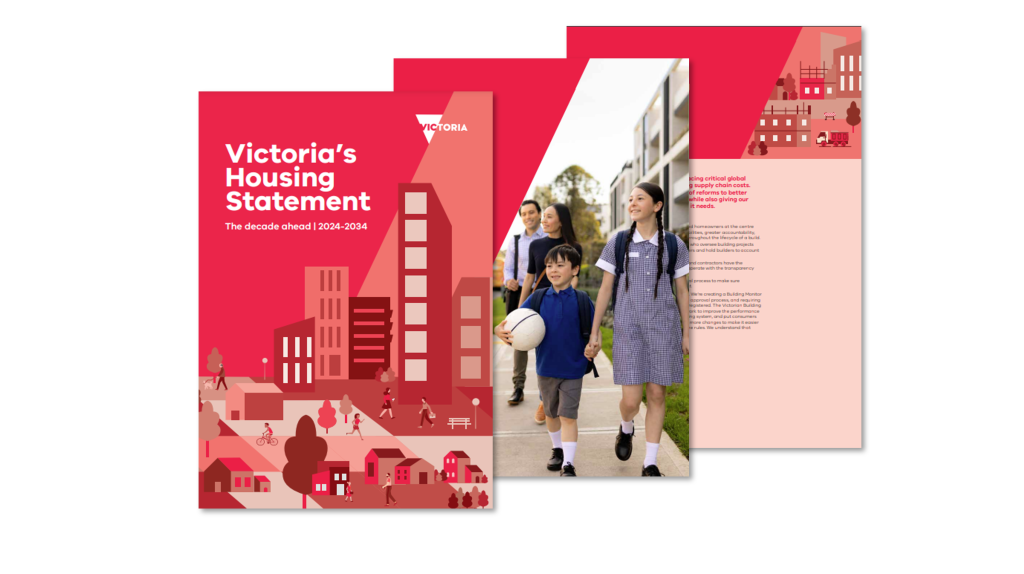
The Victorian Government has unveiled a broad suite of reforms designed to fix the state’s housing crisis.
The long-anticipated Housing Statement includes changes to planning laws, more social housing, a new short-stay levy, rent regulation and more.
This page provides a snapshot summary and analysis of these reforms.
It will be progressively updated as new information become available.
Do you have questions?
VCOSS is collecting sector questions about these reforms. We will seek clarity from the Victorian Government and arrange a member-only briefing to communicate this additional information.
Please make sure you have subscribed to receive VCOSS emails.
Ten-year strategy
What has the Victorian Government announced?
- Plan Melbourne will be refreshed to become Plan Victoria and become a ten-year planning strategy for Victoria.
- This new Plan will focus on delivering more homes near transport, job opportunities and essential services in vibrant, liveable, and sustainable neighbourhoods
- Consultation for this new Plan will occur in 2024.
What does VCOSS think?
Our sector – and other adjacent sectors – have long called for a long-term plan for housing.
VCOSS welcomes a 10-year strategy to guide sustained efforts to address the housing challenge and align housing policy with other government objectives.
Growing social housing should be a key part of Plan Victoria.
Victoria needs at least 60,000 extra social housing properties over the coming decade just to maintain current levels, based on pre-pandemic and global cost of living crisis figures.
Plan Victoria should include ambitious targets for public and community housing growth. This will drive accountability and provide a measure to monitor progress and guide action across the system.
The refresh of Plan Victoria presents an opportunity to revisit and progress previous work by government and sector partners on ideas for a 10-Year Social and Affordable Housing Plan for Victoria.
The 10-year strategy should also recognise Mana-na worn-tyeen maar-takoort, the Victorian Aboriginal and Homelessness Framework, and include measures that help advance the goal that every Aboriginal and Torres Strait Islander person should have a home.
Rent regulation
What has the Victorian Government announced?
- Ban all types of rental bidding and making it an offence to accept bids.
- Introduce a portable bond scheme.
- Increase notices of rent increases and notices to vacate periods from 60 to 90 days.
- Restrict rent increases between successive fixed-term rental agreements to protect renters from evictions so that landlords can increase the rent with a new tenancy.
- Establish Rental Dispute Resolution Victoria, a new agency to deal with rental disputes and free up VCAT.
- Make rental applications easier and protect renters’ personal information.
- Introduce mandatory training and licensing for real estate agents, property managers, owners, corporation managers and conveyancers.
- Boost funding for services that support renters, with a $2 million Rental Stress Support Package added to the Victorian Property Fund
What does VCOSS think?
Rents are too high for many Victorians and immediate and practical action is required.
These measures build on past reforms designed to make renting fairer and more predictable in Victoria.
Clamping down on rental bidding, increasing eviction notice timelines and curbing the ability of landlords to raise rents excessively when properties are turned over are common sense measures.
Victoria has led the nation on tenancy rights and rental standards.
Fairer rents are the next frontier in this reform journey.
Research shows tenancy laws are only a minor consideration when investors are deciding whether to keep a property listed on the rental market. As such, we don’t think this will have a negative impact on supply.
Planning and inclusionary zoning
What has the Victorian Government announced?
- Large planning applications (bigger than $50 million in Melbourne and $15 million in regional areas) will be fast-tracked if they include at least 10% “affordable housing”.
- If a developer wants the quick approval without including affordable housing, they must pay Homes Victoria 3% of the build’s total value, which will then be spent on social housing.
- Planning permits won’t be required for single dwellings (like granny flats) on large blocks with no overlays, if they meet minimum standards.
What does VCOSS think?
Inclusionary zoning is one part of the solution to our housing crisis.
There are thousands of new apartments and residential developments across Victoria every year.
These headline measures are a smart way to incentivise developers to contribute to growth in social housing and affordable housing.
However, they’d be even stronger if there was a legislated requirement for developers to contribute to social housing growth as a matter of course. This is a long-standing position of the Victorian Housing Peaks Alliance.
The detailed design of the policy will need to ensure that the new affordable housing stock remains genuinely affordable for people on low-incomes over the long term.
Inclusionary zoning rules in activity centres must also be designed so that tenants on low-incomes can afford to remain locally. As gentrification drives up property values, low-income residents shouldn’t be driven out.
Using surplus land
What has the Victorian Government announced?
- Rezone surplus government land across 45 sites across Melbourne and regional Victoria
- This should deliver “around 9,000 homes”.
- At least 10% of these new homes (roughly 900) will be “affordable homes”.
What does VCOSS think?
We’re in the middle of a housing crisis.
It makes sense to re-deploy vacant, unused and under-used government owned land as housing.
Measures will be required to ensure affordable housing remains genuinely affordable for people on low-incomes over the long term. While the focus of this measure is the construction of new affordable housing, VCOSS is hopeful that the inclusionary zoning measures will deliver some social housing on these sites also.
‘Affordability Partnership’
What has the Victorian Government announced?
- An Affordability Partnership will be established.
- This will involve property developers and super funds.
- It will be committed to expediting the building of more homes in Victoria.
- The partnership will drive reforms to increase supply and ensure there is more affordable housing.
What does VCOSS think?
This is a promising approach.
Similar structures exist and operate successfully at the federal level.
This Partnership should involve representatives from the community sector.
This is a mammoth agenda and we need everyone working together to realise this once-in-a-generation opportunity.
The community sector stands ready to make a positive contribution.
‘Short Stay Levy’
What has the Victorian Government announced?
- A 7.5% levy on homestay bookings.
- All money raised will got Homes Victoria to invest in housing solutions for Victorians who fare worst in the housing market.
- The fund will be spent exclusively on “building and maintaining social and affordable housing”.
- 25% of the money raised will be earmarked for regional Victoria.
- Some council charges on short stay accommodation will be scrapped
What does VCOSS think?
The trend of turning residential homes into short-stay tourist accommodation is having a corrosive effect on the rental market, especially in tourist hot-spots and inner metro suburbs.
In many areas there’s nowhere affordable for people to rent, and yet there’s an abundance of temporary tourist accommodation.
VCOSS endorses this levy as a measure that will either encourage property investors to return these homes to the long-term rental market and/or create a new source of revenue that can be used to support social housing growth.
If unchecked, the runaway popularity of homestays will continue to exacerbate housing stress and homelessness across Victoria. VCOSS unequivocally supports the money raised by this levy being used exclusively to build and maintain social and affordable housing.
Submit your question
Sector responses
- ‘Housing statement offers roadmap for struggling renters’ (Tenants Victoria)
- ‘The Victorian Government’s Housing Statement’ (Victorian Public Tenants Association)
- ‘Housing statement fails on social housing commitments’ (Council to Homeless Persons)
- ‘Andrews Government delivers a historic housing strategy for Victoria, but targeted support needed for homeless young people’ (Anglicare)

VCOSS is the peak body for Victoria’s social and community sector, and the state’s premier social advocacy body.
We work towards a Victoria free from poverty and disadvantage, where every person and community experiences genuine wellbeing. Read more.

VCOSS acknowledges the Traditional Owners of Country, and we pay respect to Elders and Ancestors. Our business is conducted on sovereign, unceded Aboriginal land. The VCOSS offices are located on Wurundjeri Woiwurrung land in central Naarm.
Social housing
What has the Victorian Government announced?
What does VCOSS think?
General comments
More than 100,000 people are currently waiting for social housing in Victoria.
Victoria needs at least 6,000 extra social housing properties each year just to maintain current levels, based on pre-pandemic and global cost of living crisis figures.
More social housing is an unequivocally good thing for Victoria – so we welcome the commitment to deliver a 10 per cent uplift in social housing through the public housing high-rise redevelopments.
This single pillar of the Housing Statement won’t, in isolation, achieve the Victorian Housing Peaks Alliance’s urgent call for 6,000 new social housing properties annually over the next decade.
However, we note the Housing Statement makes a positive commitment to a ten-year planning strategy. This strategy must establish mechanisms to enable the necessary social housing growth pipeline, as the current Big Housing Build concludes.
Social housing comprises public housing and community housing. It’s critical the government invests significantly in growing both public housing and community housing.
(See: Ten Year Strategy)
Tower rebuilds
There needs to be genuine ongoing engagement with tower tenants, who have lived in these homes and communities for decades. This process should ensure tenants feel supported, empowered and respected, and given as much clarity and certainty as possible.
Local community leaders and trusted community organisations have an important role to play in this process.
Further, tenants must have a ‘right to return’ to their original location, and be offered a place in public housing if this is their choice.
Social housing protects and supports tenants in a manner the private market cannot. As the sector expands and evolves, there must be a contemporary regulatory system for social housing that puts renters at the centre, ensures best practice tenancy management, encourages sustainable growth and provides adequate industry oversight.
The findings and recommendations of the Social Housing Regulation Review will provide the blueprint to progress these essential reforms.
Aboriginal housing
The housing crisis disproportionately impacts Victoria’s First Peoples. More than one-in-six Aboriginal and Torres Strait Islander Victorians have experienced homelessness, compared to one-in-76 non-Indigenous Victorians.
This vast overrepresentation is a direct and ongoing consequence of colonisation. The redevelopment of the public housing high-rise must take particular care to ensure First Nations people currently resident at these sites are not pushed into homelessness.
A concerted effort must be made to ensure current First Nations renters are aware of their tenancy rights and have access to appropriate housing options when towers are being rebuilt, as well as the ‘right of return’.
Furthermore, the Victorian Government should quarantine 10% of all future stock for Aboriginal Victorians, in line with Mana-na worn-tyeen maar-takoort, the Victorian Aboriginal and Homelessness Framework endorsed by the Victorian Government.